First question · Metaphysics
What can I know?
The Critique of Pure Reason surveys the limits of cognition and explains why mathematics and physics yield secure knowledge.
0/14
“Two things fill the mind with ever new and increasing admiration and awe […]: the starry heavens above me and the moral law within me.”
Source: Critique of Practical Reason (1788), Conclusion, Ak. 5:161; our translation — Wikipedia
Thirty seconds, an example from Kant himself. First you guess, then you play out what such a world would look like.
Someone is short of money. He knows he will never be able to pay back a loan, and he also knows that nobody will lend him anything unless he firmly promises to repay it on time. So he promises anyway. In the “Groundwork of the Metaphysics of Morals” (1785) Kant uses this case to show how to test a rule of action: you imagine it held for everyone.
When I am short of money, I borrow money and promise to pay it back, although I know I never will.
Your guess: what happens if everyone acts like this?
Tap your guess first, then the slider opens.
Who still lends on the strength of a promise? 6 of 6 A model, not a measurement
What Kant concludes
–
“For the universality of a law that everyone, once he believes himself to be in need, could promise whatever occurs to him with the intention of not keeping it, would make the promise itself, and the end one may have with it, impossible, since no one would believe that anything was promised him, but would laugh at all such utterances as vain pretence.” Groundwork, Ak. 4:422; our translation
The rule presupposes that people believe promises, and as a law for everyone it abolishes promising itself. That is why, for Kant, it cannot even be thought without contradiction (Ak. 4:424). The bad outcome alone is not his reason.
“All he shows is that the consequences of their universal adoption would be such as no one would choose to incur.” Mill on Kant's derivation of duties, Utilitarianism (1861), ch. 1
For Mill, Kant's test secretly weighs consequences after all.
One more star on your star map.
Sources: Kant, Groundwork of the Metaphysics of Morals (1785), Ak. 4:422; our translation — Kant corpus (German) · Ak. 4:424 (contradiction in thought, an exception for oneself) · John Stuart Mill, Utilitarianism, ch. 1 — Project Gutenberg · Wikipedia: Categorical imperative (Deception)
Kant brought the whole field of philosophy down to four questions. Behind each door you will find chapters and devices for testing ideas yourself.
The Critique of Pure Reason surveys the limits of cognition and explains why mathematics and physics yield secure knowledge.
The categorical imperative makes morality a matter of reason: can I will that my rule of action become a law for everyone?
The highest good, God and immortality, progress in history and perpetual peace: what reason may hope for.
“At bottom, however, all of this could be counted as anthropology, because the first three questions relate to the last.”
Kant, Logic (1800), Ak. 9:25; our translation
Kant attempted an answer from experience in his “Anthropology from a Pragmatic Point of View”: he gave the lectures from 1772/73 to 1795/96, and the book appeared in 1798.
Which chapters stand behind which door is a division for learning, not Kant's own.
Sources: Kant, Logic, ed. G. B. Jäsche (1800), Ak. 9:25; our translation — Kant corpus (German) · Critique of Pure Reason, Ak. 3:522 f. (the first three questions) · Wikipedia: Anthropology from a Pragmatic Point of View (lectures 1772–1796)
A new case for debate every day, the same one for everybody. Kant usually invited friends to his midday meal.
Pick up where you left off and see how many stars you have collected behind each door. Everything stays in your browser.
The essentials up front — each topic leads to its own chapter.
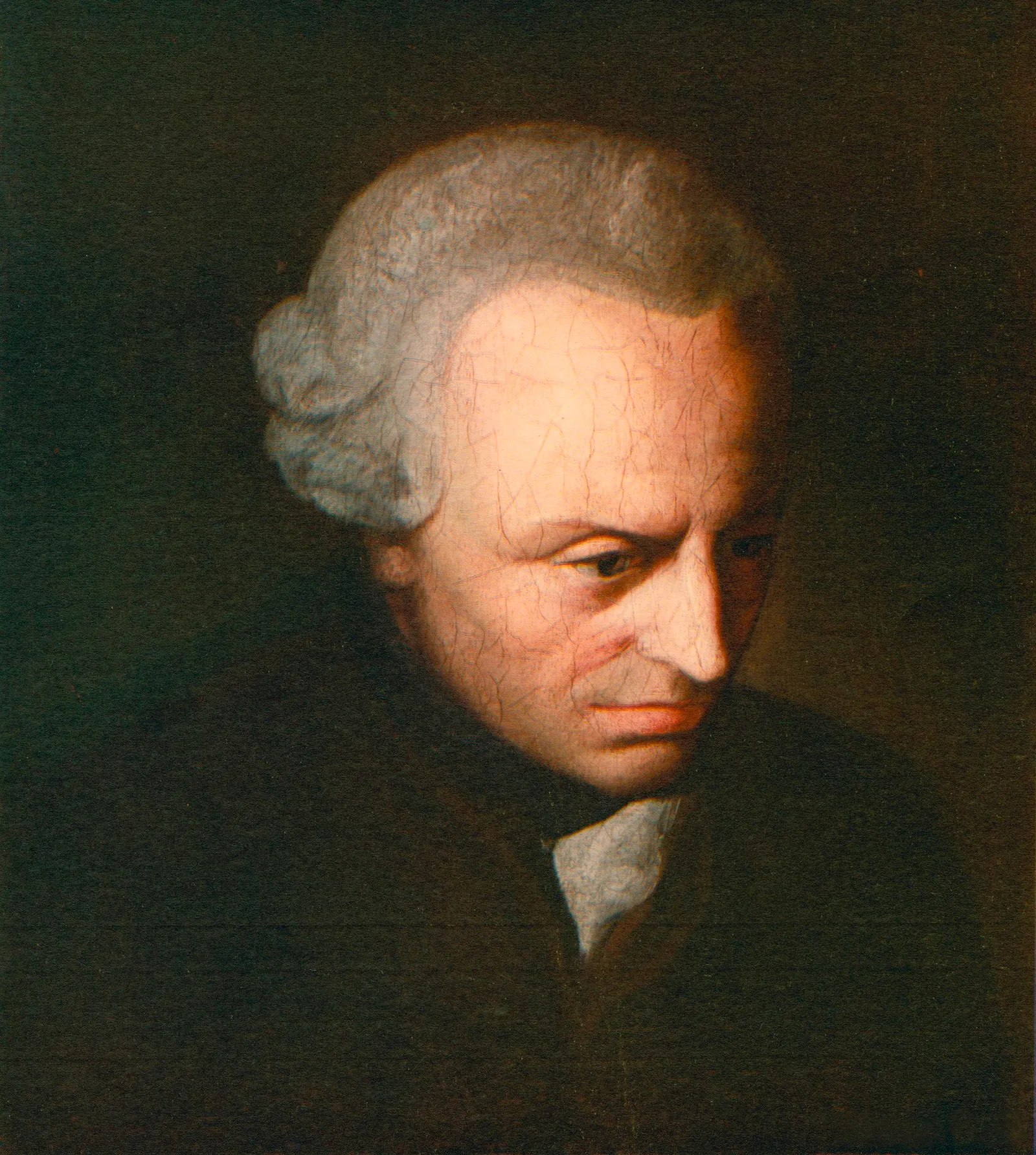
Immanuel Kant (1724–1804), Enlightenment philosopher, spent almost his entire life in Königsberg (Prussia), where he became professor of logic and metaphysics in 1770.
His “Copernican revolution”: our cognition does not conform to things — things, as we know them, conform to the forms of our cognition (space, time, categories).
We only ever know appearances, never the thing in itself. Precisely this limit makes secure natural science possible — and leaves room for freedom and morality.
The categorical imperative tests rules of action for universalisability. Human beings are ends in themselves — never mere means.
From human dignity in constitutional law (the “object formula” of the Basic Law commentary goes back to Kant) to the idea of a league of nations: few thinkers shape ethics, law and politics as strongly to this day.
Sources: Wikipedia: Immanuel Kant · Wikipedia: Critique of Pure Reason
The motto of enlightenment · 1784
Have courage to use your own understanding!
Chapter VI · Enlightenment →Source: Kant, An Answer to the Question: What Is Enlightenment? (1784), Ak. 8:35 — Wikipedia
All chapters and work portraits in one go, in book order — 17 parts, 1 h 49 min in total. The player keeps going while you browse the site.