The beautiful, the sublime and the purposes of nature
After the reason of knowing and the reason of acting, Kant's system still lacks one piece: a bridge. Building it is the task of his third Critique.
The “Critique of Judgment” (1790, published by Lagarde und Friederich, Berlin and Libau) — the third and final of the three Critiques.Image: Immanuel Kant · Public domain · Wikimedia Commons
The first two Critiques had surveyed two worlds that never touch: the Critique of Pure Reason describes a nature in which everything happens according to deterministic laws; the Critique of Practical Reason a moral world governed by freedom. If these two realms are not to stand irreconcilably side by side, something must mediate between them. In 1790 Kant published the Critique of Judgment for exactly this purpose — and its bridge-builder is a faculty of its own, the power of judgment, which must overlap both the understanding and reason.
Determinative judgment
The universal is already given — a rule, a law, a concept — and the particular case is subsumed under it. This is how science works when it brings an observation under a known law.
Reflective judgment
Only the particular is given — and the fitting universal has yet to be found. This is the faculty the whole book is about: it is at work when we call something beautiful, or grasp an organism as purposive.
Reflective judgment brings its own principle with it a priori: purposiveness — the appearance of design, the expectation of finding order rather than chaos in nature. Along this guiding thread Kant examines two fields of experience: aesthetic judgment about the beautiful and the sublime in the first part, teleological judgment about the purposes of nature in the second.
“This is beautiful” — what kind of judgment is that? Kant's answer remains one of the most influential analyses of taste ever written.
Sort each thing: is it agreeable, beautiful or good? Kant's two test questions help you. Then you see how Kant himself judges.
A glass of Canary wine
Kant's two test questions
Do you need a concept of what the thing is meant to be or what it is for? Then it is good (useful or good in itself). § 4, Ak. 5:207
Are you speaking only for yourself, or do you expect the same judgment of everyone? Only for yourself: agreeable. For everyone, without a concept: beautiful. § 7, Ak. 5:212
“Agreeable is what gratifies someone; beautiful, what merely pleases him; good, what is esteemed, approved …” (own translation)
What the picture leaves out
The buttons pretend the answer lies in the thing. For Kant it lies in the way you judge: the same rose can be agreeable (smelled) or beautiful (looked at). And “beautiful” does not mean that everyone will agree; you merely expect it of them.
Whoever calls a landscape or an artwork beautiful is not stating a fact about the object — and yet is not merely reporting a private preference either. Kant's key term is disinterested pleasure: delight that does not depend on the object's existence or usefulness, on owning or consuming it. That separates the beautiful both from the merely agreeable — “this steak tastes good” expresses a pleasure bound to appetite — and from the morally good, which pleases through a concept. Kant dissects the judgment of taste into four “moments”:
Quality: disinterestedness
The beautiful pleases in mere contemplation, without any interest in the object's existence. The agreeable, by contrast, is tied to desire — we want the thing to be there for us.
Quantity: subjective universality
No concept and no proof can compel anyone to find something beautiful. Yet the judgment is made with the claim that others ought to agree — whoever says “beautiful” speaks, as it were, with a universal voice.
Relation: purposiveness without purpose
A beautiful form seems designed for our cognition — as if made for a purpose — although no actual purpose can be stated. Kant adds a distinction: free beauty (ornament, a graceful line) needs no concept at all, while adherent beauty (a well-built horse) is judged against what the thing is for.
Modality: necessity of assent
The expected agreement is claimed not as a statistical majority taste but as necessary — grounded in a sensus communis, a common sense of taste we impute to everyone.
Why does the beautiful please at all? Because its form fits our cognitive powers and sets imagination and understanding into a free play in which they animate each other, with no concept to end the game. This idea — together with the paradox of a judgment that is subjective yet claims universal validity — has kept Kant's aesthetics alive in debates about art to this day.
Storms, mountain ranges, the starry sky: some things in nature overwhelm us — and precisely in doing so lift us up.
A hurricane over the sea, waves higher than a house. Commit to an answer first, then move the slider.
When does this sight become sublime for you?
on the shipon the safe rock
Three voices
You
Kant
The storm becomes sublime only in safety; then reason discovers its superiority over nature (Ak. 5:261 f.).
Edmund Burke
Edmund Burke (Philosophical Enquiry): the sublime can evoke horror; pleasure arises because we know the danger does not really reach us. Burke explains it by its effect on our feelings.
What the picture leaves out
The slider turns Kant's thought into a change of place. For Kant, though, what matters is not the distance in metres but that the fear is not in earnest and that reason becomes aware of its own vocation. “Thus sublimity is contained in no thing of nature, but only in our mind” (Ak. 5:264, own translation). Nor does he mean a thrill like a roller coaster.
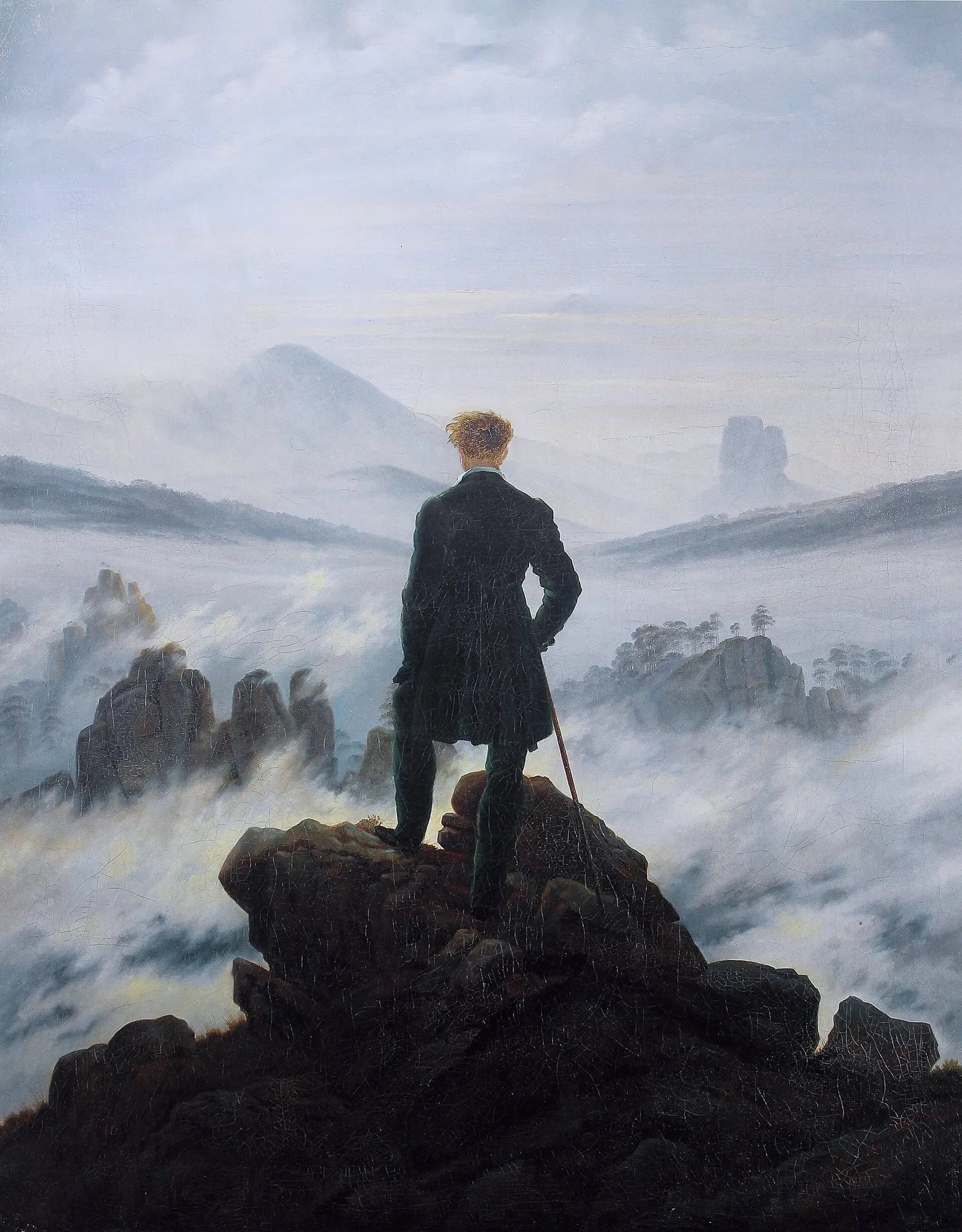
Caspar David Friedrich's “Wanderer above the Sea of Fog” was painted decades after the Critique of Judgment — but it has become the emblem of what Kant called the sublime.Image: Caspar David Friedrich · Public domain · Wikimedia Commons
We call that sublime which is absolutely great.
Kant, Critique of Judgment (1790), § 25 (Ak. 5:248), transl. J. H. Bernard
Beside the beautiful, aesthetic judgment knows a second, darker experience. Where beauty attaches to bounded form, the sublime is found in the formless and boundless. Kant distinguishes two shapes of it: the mathematical sublime concerns sheer magnitude that defeats every standard of measurement — the endless expanse of the starry heavens; the dynamical sublime concerns might — nature considered as a power against which our resistance counts for nothing, yet which, judged aesthetically, has no dominion over us. We may find it fearful without actually being afraid of it.
1
The senses fail
Confronted with the overwhelming, the imagination can no longer take the whole in at once — we experience the inadequacy of our sensibility.
2
Reason answers
But the very fact that we can think the boundless reveals a faculty of the mind surpassing every standard of sense: reason and its ideas.
3
The reversal
Displeasure turns into a peculiar, serious pleasure: the defeat of the senses becomes the discovery of our supersensible vocation, which no power of nature can touch.
Strictly speaking, then, it is not the ocean or the mountain range that is sublime, but the mind that discovers its own greatness in facing them — the sublime belongs to reason, not to things.
The mathematical sublime: the endless expanse of the starry sky — for Kant also one of the two objects of “ever new and increasing admiration and awe”.Image: ESO/Y. Beletsky · CC BY 4.0 · Wikimedia Commons
How does beauty made by human hands come about? Kant's answer retires a doctrine that had ruled art theory since antiquity.
For two thousand years art had been understood as imitation — mimesis — of nature. Kant breaks with this principle and relocates creativity in the subject: fine art springs from genius, a natural endowment that gives the artist exceptional imagination and originality. Genius is the productive counterpart of taste — where judgment recognises the beautiful, genius is the talent for producing it. And since this gift is nature's work in the artist, nature itself, through the genius, gives the rule to art: no academy, no rulebook makes a work beautiful; the rule arrives with the work.
At the same time the artist is no mere mouthpiece of nature: art remains production through freedom, involving skill, labour and intention. That is why genius needs a second faculty at its side — taste, which mediates between imagination and understanding and gives the original idea communicable form.
The second half of the book turns from artworks to living beings — and asks how we can make sense of organisms at all.
A clockwork is understood once every part is traced back to its causes. With a living being that is not enough: organisms are natural purposes — things whose parts exist for the sake of their whole, and whose whole exists for the sake of its parts. They grow, heal and reproduce; an inner purposiveness distinguishes them from mere machines. Kant is emphatic that mechanical explanation remains the standard of science — and yet he considers it absurd to hope that some day “another Newton” might arise who could explain so much as a blade of grass without invoking purposes.
Does that mean purposes really exist in nature? Here Kant draws a sharp line: we must judge organic beings as if they were constituted teleologically. The concept of a purpose is not a category that constitutes knowledge of objects — it is a rule that reflective judgment gives to itself.
The third Critique has occupied aesthetics and the theory of art for centuries since.
Schiller and aesthetic education
In his Letters on the Aesthetic Education of Man, Friedrich Schiller engages directly with Kant: his famous “play drive” (Spieltrieb), which is to reconcile the sensuous and the formal drives in human nature, is — like a number of his other terms — derived from the Critique of Judgment.
German Idealism and its critics
Fichte and Schelling held the human mind to be an “intuitive understanding” that produces its objects — Kant himself had considered the concept only as a limiting concept for a different (divine) understanding and consistently denied it for humans. Schopenhauer, in turn, objected that Kant analysed the judgment about beauty instead of perceived beauty itself.
The twentieth century
Kant's discussions of schema and symbol left their mark on continental philosophy: Jacques Derrida studied the book extensively, Hans-Georg Gadamer developed his hermeneutics against what he saw as Kant's ahistorical aesthetics, and Hannah Arendt suggested that the sensus communis might ground a Kantian political theory.