The End of All Things
A philosopher of reason writes about the apocalypse: in this short essay Kant asks why human beings expect an end of the world at all — and what reason can say about the passage from time into eternity. The result is one of his most unusual texts: ironic, at places sombre, and written right into the censorship dispute of his day.
Genesis & context
An essay on the Last Judgment — published while the censors were watching Kant's writings on religion.
The essay appeared in June 1794 in the Berlinische Monatsschrift — the Berlin Enlightenment journal, edited by Johann Erich Biester, that is considered Kant's preferred magazine and had carried his famous answer to the question “What is Enlightenment?” a decade earlier. In a letter of 10 April 1794 Kant announced the piece with dry humour, saying it would read as “partly doleful, partly funny”. That double tone is the programme: a text about the end of all things that takes the sublimity of its subject seriously while ironising the enthusiasm around it.
Sources: Wikipedia (German): Das Ende aller Dinge (publication, letter of 10 April 1794) · Wikipedia: Berlinische Monatsschrift
The circumstances were delicate. Under King Frederick William II, censorship of religious writing had tightened, and Kant himself was in the line of fire: his book on religion had already met opposition from the king's censorship commission in 1792, and on 1 October 1794 — four months after the essay — a royal rescript (cabinet order) accused him of distorting and degrading Scripture and Christianity and demanded that he give an account and not offend again (Ak. 7:6). Kant answered on his own initiative that, as His Majesty's “most faithful subject” (for that king's lifetime), he would refrain from all public lectures on religion, in lectures as well as in writings (Ak. 7:10). “The End of All Things” appeared in June 1794, before that rescript but in an increasingly tense climate — an essay on religion at the edge of the permissible, written by an author who knew he was being read.
Sources: Wikipedia: Immanuel Kant (censorship conflict, royal rescript of 1794) · Kant, The Conflict of the Faculties, Preface (Ak. 7:6–10) · Wikipedia (German): Das Ende aller Dinge
Structure & core theses
From a pious phrase to a question for reason: Kant distinguishes three ways of thinking the “end”.
The starting point is an expression of pious language: a dying person, people say, goes “from time into eternity” (Ak. 8:327). Kant takes it literally and asks what it could mean for time itself to cease and eternity to begin. Strictly speaking, we cannot think this at all — the idea, he says, carries something horrifying in it, and yet it attracts us irresistibly. One of the essay's guiding questions is therefore not when the world will end, but why we humans expect such an end in the first place. (The title alludes to 1 Peter 4:7: “But the end of all things is at hand”.)
Sources: Kant, The End of All Things, Ak. 8:327 · Wikipedia (German): Das Ende aller Dinge (introduction; title)
Why, though, do human beings expect an end of the world at all?
Kant, The End of All Things (1794), Ak. 8:330, translated
- 1The natural end
The end as moral reason can conceive it: related to humanity's final purpose, the highest good. Here talk of an “end” has a rational, practical sense — it orients our action towards a goal.
- 2The mystical end
The supernatural end, of which we comprehend nothing: it lies beyond what is accessible to reason. Kant marks his distance from enthusiast mysticism here — with side glances at Laozi, pantheism and Spinozism.
- 3The unnatural (perverse) end
The end that human beings bring about themselves by misunderstanding the final purpose: a self-inflicted moral inversion. At this point the essay turns political — aiming at a Christianity that relies on coercion instead of freedom.
Source: Wikipedia (German): Das Ende aller Dinge (the three kinds of end)
The opening of the essay
The End of All Things · Ak. 8:327
Kant's German original
Es ist ein vornehmlich in der frommen Sprache üblicher Ausdruck, einen sterbenden Menschen sprechen zu lassen: er gehe aus der Zeit in die Ewigkeit. Dieser Ausdruck würde in der Tat nichts sagen, wenn hier unter der Ewigkeit eine ins Unendliche fortgehende Zeit verstanden werden sollte; denn da käme ja der Mensch nie aus der Zeit heraus, sondern ginge nur immer aus einer in die andre fort.
The exercise uses our own close translation, which keeps Kant's sentence structure.
Which parts can you leave out without the sentence falling apart? Tap them and they step back. Then check your choice.
It is a common expression, especially in pious language, to have a dying person say: he is passing out of time into eternity. This expression would in fact say nothing if eternity were to be understood here as a time going on into infinity; for then the human being would never get out of time, but would only ever pass from one time into another.
Plain words: our paraphrase, not a Kant quotation
Pious people like to say that a dying person passes out of time into eternity. Kant tests this: if eternity were just time running on without end, a person would never get out of time. So the sentence only makes sense if eternity is something entirely different from time.
The slider unlocks once you have checked your choice.
The frame: It is a common expression to have a dying person say: he is passing out of time into eternity. This expression would in fact say nothing if eternity were to be understood here as a time going on into infinity.
Stepping back does not mean unimportant. The “for” clause gives the reason, and it is vivid: endless time would only be a passing from one time into the next, not a way out of it.
Key words
Once you have checked your choice, the underlined words can be opened.
Tap an underlined word in the sentence.
pious language (fromme Sprache)
- In Kant
- Religious ways of speaking, as known from sermons and prayers.
- In everyday speech
- In everyday German, “fromm” often means meek and docile: “as meek as a lamb”.
- Easy to confuse
- Not meek but religious is meant. Kant takes the pious phrase at its word and tests what it can mean at all.
eternity (Ewigkeit)
- In Kant
- Here not an infinitely long time but an end of all time in which the human being nonetheless continues to exist. Kant draws this conclusion in the next sentence (Ak. 8:327).
- In everyday speech
- “This is taking forever!” means: a very, very long time.
- Easy to confuse
- That is exactly what Kant does not mean. Eternal in the sense of “on and on without end” would just be more time, not a way out of it.
Impact & significance today
A small text with a wide arc — and a strikingly topical final point.
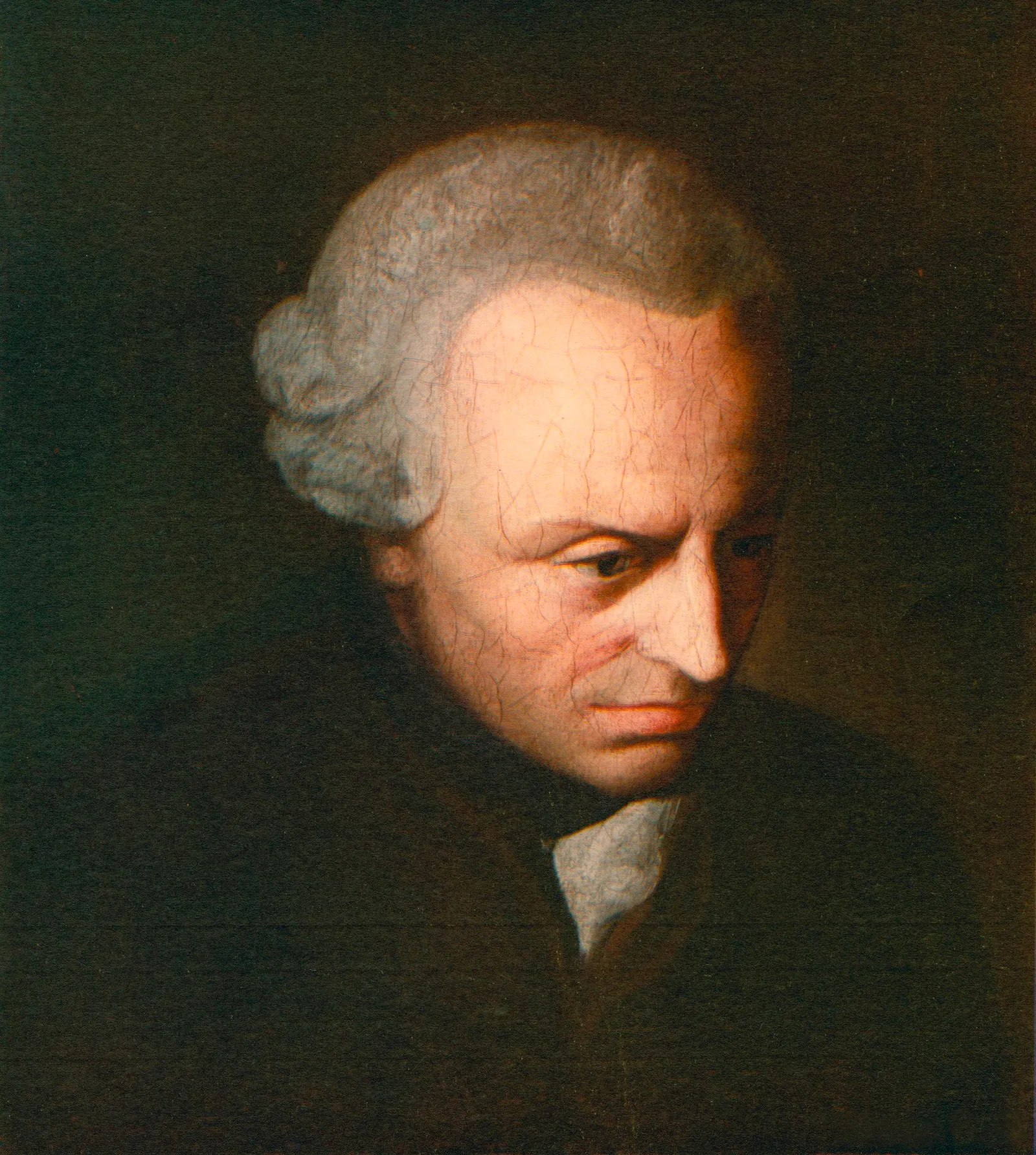
In a few pages the essay gathers motifs from Kant's major works: the limits of knowledge from the Critique of Pure Reason, the moral goal from the Critique of Practical Reason, and the rational religion of his book on religion. Eternity remains theoretically out of reach — but as a practical idea it keeps its weight, holding before us what our action, taken as a whole, is for.
Source: Wikipedia (German): Das Ende aller Dinge (place within Kant's work)
The closing point is a warning that readers in 1794 could well take as an answer to the censors: a Christianity that ceased to be lovable and was enforced by authority instead would produce the “Antichrist” — and with it the perverse end of all things. For Kant, religion wins hearts only through freedom and a liberal cast of mind, never through decree and pressure. This defence of a religion of freedom against every authoritarian piety keeps the essay worth reading today; scholars also read it as an Enlightenment engagement with apocalyptic discourse — a pattern of thought that by no means ended with the eighteenth century.
Source: Wikipedia (German): Das Ende aller Dinge (conclusion, interpretations)