Answering the Question: What Is Enlightenment?
A short magazine reply that gave an entire epoch its definition: Kant's answer to a Berlin footnote became the manifesto of the Enlightenment — and its opening line one of the most famous sentences in German philosophy.
Source: Wikipedia: Answering the Question: What Is Enlightenment?
Genesis & context
It did not start as a philosophical prize question but as a very practical quarrel about marriage.
In September 1783 Johann Erich Biester — co-editor, with Friedrich Gedike, of the Berlinische Monatsschrift (Berlin Monthly) — published an essay proposing that the clergy no longer be involved in the conduct of marriages. The Reverend Johann Friedrich Zöllner — a Berlin preacher who later became a Prussian consistorial councillor — objected in December 1783, and in his reply posed the question that would become the watchword of the age: what is enlightenment?
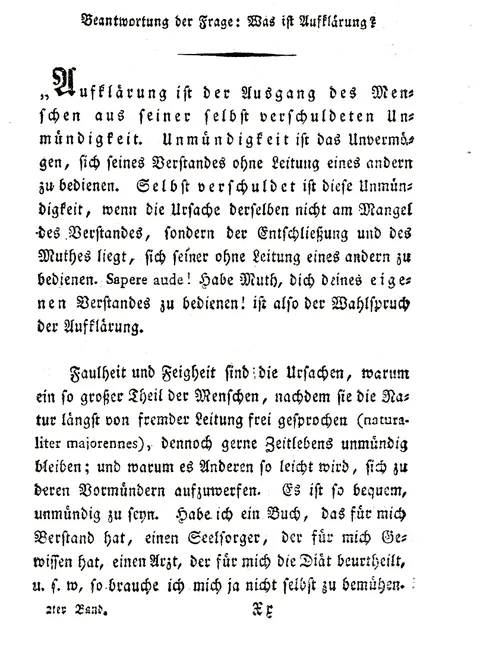
The question was addressed to the broad intellectual public, and a number of leading minds sent in answers. Kant's reply appeared in the December 1784 issue of the journal — and of all the answers it is the most famous and the one that has had the greatest impact. Its opening paragraph, a much-cited definition, locates the lack of enlightenment not in a lack of intellect but in a lack of courage to think for oneself.
Source: Wikipedia: Answering the Question: What Is Enlightenment?
Core theses
The essay opens with the definition — everything else unfolds from it.
Enlightenment is man's release from his self-incurred tutelage. […] Sapere aude! “Have courage to use your own reason!” – that is the motto of enlightenment.
Kant, Answering the Question: What Is Enlightenment? (1784), transl. L. W. Beck (Kant's word is “Verstand”, i.e. understanding)
Every word is load-bearing: enlightenment is not a state but a release, a movement each person must make for themselves — and because the obstacle is not a missing intellect but missing courage, the immaturity is self-incurred. Four steps unfold the diagnosis:
- 1Self-incurred immaturity
Immature is whoever cannot use their own understanding without direction from another. It is self-incurred when the cause is not a lack of intellect but a lack of courage and resolution. People conditioned like “domestic cattle” by their guardians find it comfortable never to question what they have been told.
- 2Sapere aude!
The Latin motto — “dare to know”, or “have the courage to use your own understanding” — goes back to a verse epistle by the Roman poet Horace. Kant claimed it as the motto of the entire Enlightenment: a charge to intellectual self-liberation by means of reason, addressed to courage rather than intelligence.
- 3Public and private use of reason
Kant distinguishes the public use of one's reason — arguing as a scholar before the reading public, which must always be free — from the private use: reasoning from a specific civic office or post, which may be restricted. The same officer who must obey on duty may publicly analyse the flaws of the service as a writer. Criticism and obedience have different places, and reform runs through the public sphere.
- 4An age of enlightenment
Kant's sober verdict on his own present: not yet an enlightened age, but an age of enlightenment — a movement under way rather than a finished achievement, with religious tutelage as its main battleground.
Sources: Wikipedia: Sapere aude (Kant's use of the motto) · Wikipedia: Public reason (Kant's distinction) · Full text of the essay on Wikisource
The three opening sentences
What Is Enlightenment? · Ak. 8:35
Kant's German original
Aufklärung ist der Ausgang des Menschen aus seiner selbst verschuldeten Unmündigkeit. Unmündigkeit ist das Unvermögen, sich seines Verstandes ohne Leitung eines anderen zu bedienen. Selbstverschuldet ist diese Unmündigkeit, wenn die Ursache derselben nicht am Mangel des Verstandes, sondern der Entschließung und des Mutes liegt, sich seiner ohne Leitung eines andern zu bedienen.
The exercise uses our own close translation, which keeps Kant's sentence structure.
Which parts can you leave out without the sentence falling apart? Tap them and they step back. Then check your choice.
Enlightenment is the human being's emergence from his self-incurred immaturity. Immaturity is the inability to make use of one's understanding without direction from another. This immaturity is self-incurred when the cause of it lies not in a lack of understanding but in a lack of resolution and courage to make use of it without direction from another.
Plain words: our paraphrase, not a Kant quotation
Enlightenment means: stop letting others do your thinking for you. Immature is whoever uses their understanding only under someone else's guidance. And it is your own fault if you could in fact think for yourself but do not dare to, or do not make up your mind to.
The slider unlocks once you have checked your choice.
The frame: Enlightenment is the human being's emergence from his self-incurred immaturity. Immaturity is the inability to make use of one's understanding without direction from another. This immaturity is self-incurred when the cause of it lies not in a lack of understanding but in a lack of resolution and courage.
Stepping back does not mean unimportant. Almost everything here is frame: three definitions, each building on the one before. The ending only repeats what resolution and courage are lacking for.
Key words
Once you have checked your choice, the underlined words can be opened.
Tap an underlined word in the sentence.
immaturity (Unmündigkeit)
- In Kant
- The inability to use one's own understanding without direction from another. Kant defines it himself in the next sentence.
- In everyday speech
- In German law, “unmündig” describes minors: children who may not yet decide for themselves.
- Easy to confuse
- It has nothing to do with age. Adults stay immature too if they rely on “a book that has understanding for me” (Ak. 8:35, our translation).
understanding (Verstand)
- In Kant
- The ability to think and to judge that every human being has.
- In everyday speech
- “Having understanding” often means being clever, a bright mind.
- Easy to confuse
- Kant says precisely that the immature do not lack intelligence: the cause lies “not in a lack of understanding”.
resolution (Entschließung)
- In Kant
- The decision actually to do something; together with courage, the real bottleneck.
- In everyday speech
- In today's German an “Entschließung” is usually a parliamentary resolution.
- Easy to confuse
- Not a committee's decision, but resolve. The motto that follows fits it: “Have courage to make use of your own understanding!” (Ak. 8:35, our translation).
Sources: German original (korpora.org): Ak. 8:35 · German original (korpora.org): Ak. 8:36
Impact & relevance today
An occasional piece of a few pages — and perhaps the most quoted stretch of German Enlightenment prose.
Of all the answers Zöllner's question received, Kant's is the one that made history: it turned a magazine debate into the epoch's self-definition, and Sapere aude into the motto of the Enlightenment as a whole. The essay's core idea — that enlightenment is a task each person and each generation must take up anew — is what has kept it alive far beyond the eighteenth century.
Exactly two hundred years later, in 1984, Michel Foucault returned to the text with an essay of the same title, engaging with Kant's formulation and attempting to relocate its questions within late twentieth-century philosophy — proof that the debate the little essay opened has never quite closed. Kant's own verdict, an age of enlightenment rather than an enlightened age, had built that open horizon in from the start.
For a close reading of the essay — with all the examples of the two uses of reason and the double-edged praise of the king — see the Enlightenment chapter.
Sources: Wikipedia: Answering the Question: What Is Enlightenment? · Wikipedia: Sapere aude (reception, Foucault)