Kant never left East Prussia, yet his century was in motion: wars, revolutions, Enlightenment. Filter the timeline by life, works and world events.
1724
Born in Königsberg. Immanuel Kant is born on 22 April, the fourth child of master saddler Johann Georg Kant.
1732
Collegium Fridericianum. He enters the Pietist Latin school — drill and piety that Kant would later view critically.
1740
Studies at the Albertina. At 16 Kant begins his studies at the University of Königsberg (philosophy, mathematics, natural science).
1740
Frederick II becomes king. Frederick the Great's reign begins in Prussia — the political climate of the Enlightenment.
1755
Magister & Privatdozent. Doctorate and habilitation; as a private lecturer Kant lives on student fees for fifteen years (from 1766 with a small librarian's salary on top).
1755
Universal Natural History. Early work on cosmology: the origin of the planetary system from a primordial nebula (Kant–Laplace theory).
1756–63
Seven Years' War. Königsberg is under Russian occupation 1758–1762 — Kant keeps teaching, lecturing among others to Russian officers.
1770
Professorship. After declining calls elsewhere, finally: full professor of logic and metaphysics in Königsberg.
1776
American independence. The Declaration of Independence appeals to natural law and unalienable rights — Enlightenment ideas.
1781
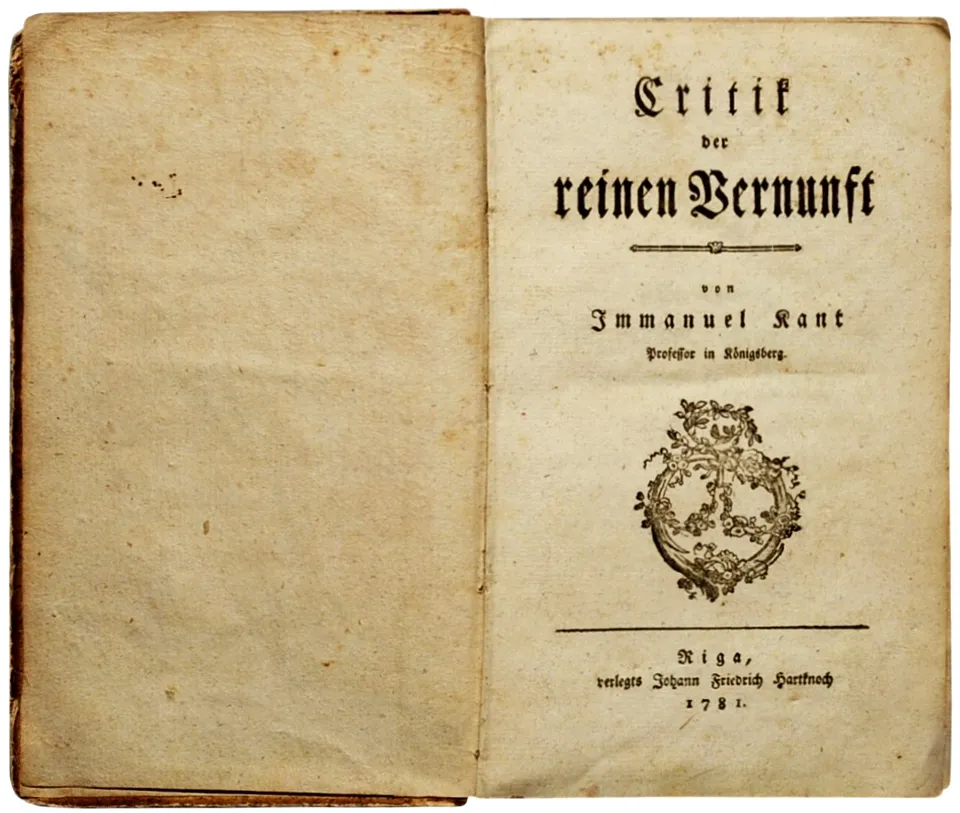
Critique of Pure Reason. After the “silent decade” the epochal main work appears — at first barely understood.
1784
What Is Enlightenment?. The essay with the motto “Sapere aude!” appears in the Berlinische Monatsschrift.
1785
Groundwork of the Metaphysics of Morals. The categorical imperative is formulated — the foundation of Kant's ethics.
1788
Critique of Practical Reason. The second Critique: freedom, the moral law and the famous “two things” of its conclusion.
1789
French Revolution. Kant follows the Revolution with keen interest — a talking point of his dinner circles.
1790
Critique of Judgment. The third Critique unites the beautiful, the sublime and the purposiveness of nature.
1794
Conflict with censorship. Over his book on religion, Frederick William II reprimands Kant in a rescript of 1 October 1794; Kant himself promises to abstain from public statements on religion — for as long as the king lives.
1795
Perpetual Peace. The peace essay: republican constitutions, a federation of free states, cosmopolitan right.
1797
The Metaphysics of Morals. Doctrine of Right and Doctrine of Virtue — Kant's worked-out moral and legal philosophy.
1798
Anthropology from a Pragmatic Point of View. From his most popular lectures: what is the human being — as a freely acting citizen of the world?
1804
Death in Königsberg. Kant dies on 12 February. According to tradition his last words were: “It is good.”
1946
Königsberg becomes Kaliningrad. After the Second World War the city passes to the Soviet Union; Kant's tomb at the cathedral is preserved.
2024
300th birthday. Worldwide anniversary programmes, conferences and exhibitions for the 300th birthday.
Reference: First edition, Riga 1781 (edition A) · Source
The Critique of Pure Reason appeared in 1781 with Johann Friedrich Hartknoch in Riga, still spelt “Critik” on the title page. The heavily revised second edition (B) followed in 1787, which is why quotations often give A and B page numbers.