1 · No sham peace
No peace treaty shall count as valid if it is made with a secret reservation of material for a future war. Whoever merely postpones open disputes concludes not a peace but a truce.
Can there be lasting peace between states — not as a stroke of diplomatic luck, but as a condition guaranteed by law itself? Kant's answer of 1795 is one of the most famous peace proposals in the history of philosophy.
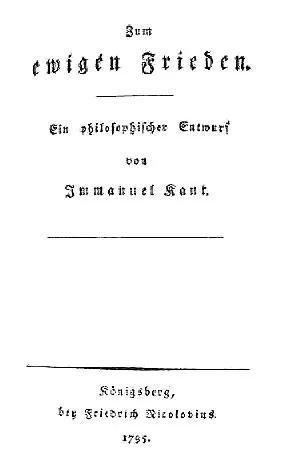
In April 1795 Prussia signed a separate peace with revolutionary France at Basel — negotiated by courier between the envoys' lodgings, and complete with a secret article in which Prussia accepted French control of the left bank of the Rhine. In the same year a slim essay appeared in Königsberg: “Perpetual Peace: A Philosophical Sketch”, followed by an expanded second edition in 1796. Its very first article takes aim at treaties exactly like the one signed at Basel: a peace concluded with a secret reservation of material for a future war is no peace at all.
Even the form makes a point: Kant lays the essay out like an international treaty — with preliminary articles, definitive articles, supplements and appendices, and in its final form even a “secret article” of his own. And the title comes with a wink: Kant alludes to the satirical inscription on the sign of that Dutch innkeeper, on which a churchyard was painted, and leaves open whether it applies to humanity at large, especially to heads of state, or merely to philosophers (Ak. 8:343). Behind the joke lies caution: with a saving clause Kant shields himself against the censors — what follows, he suggests, is merely a philosopher's thought experiment no statesman need fear.
Sources: Wikipedia: Perpetual Peace: A Philosophical Sketch · Wikipedia: Peace of Basel (April 1795, secret article) · German Wikipedia: Zum ewigen Frieden (innkeeper's sign, editions)
Before the articles follow one by one: what would a treaty have to contain so that it does not merely end one war but prevents future ones?
Kant opens his sketch with a hard distinction. A peace settlement that merely postpones what will later cause conflict again is “a mere truce, a postponement of hostilities, not peace, which means the end of all hostilities” (Ak. 8:343). A real peace must remove the causes of future wars. That is why the essay has two sections: six prohibitions that clear away, and three articles that build. And even the federation is for Kant only the “negative surrogate” of a world republic: it merely holds back the “stream of the hostile inclination that shies away from right”, “yet with constant danger of its breaking out” (Ak. 8:357). Quotations in own translation.
Three exhausted powers sit at the negotiating table: Arvenland, Lyrmark and Tessburg (all three invented). You write the treaty. Include what seems right to you for a lasting peace, and leave out what does not belong in it.
Without JavaScript the treaty cannot be assembled. Kant's articles are given with each clause, the answer below.
Definitive article 1
“The civil constitution in every state shall be republican.” Perpetual Peace (1795), Ak. 8:349, own translation
Preliminary article 1
“No conclusion of peace shall be held valid as such if it was made with a secret reservation of the material for a future war.” Perpetual Peace (1795), Ak. 8:343, own translation
Preliminary article 3
“Standing armies (miles perpetuus) shall in time cease altogether.” Perpetual Peace (1795), Ak. 8:345, own translation
Definitive article 2
“The right of nations shall be founded on a federalism of free states.” Perpetual Peace (1795), Ak. 8:354, own translation
Preliminary article 2
“No independently existing state (whether small or large, it makes no difference here) shall be acquired by another state through inheritance, exchange, purchase or gift.” Perpetual Peace (1795), Ak. 8:344, own translation
Preliminary article 4
“No national debt shall be contracted in connection with the external affairs of the state.” Perpetual Peace (1795), Ak. 8:345, own translation
Definitive article 3
“Cosmopolitan right shall be limited to the conditions of universal hospitality.” Perpetual Peace (1795), Ak. 8:357, own translation
Preliminary article 5
“No state shall forcibly interfere in the constitution and government of another state.” Perpetual Peace (1795), Ak. 8:346, own translation
Kant's exception: if a state splits into two parts that each claim the whole, aiding one part is no interference, because then there is anarchy. But as long as the internal conflict is undecided, any intervention from outside remains forbidden (Ak. 8:346).
Preliminary article 6
“No state at war with another shall permit itself such acts of hostility as would make mutual confidence in a future peace impossible …” Perpetual Peace (1795), Ak. 8:346, own translation
A treaty built to Kant's plan: six prohibitions respected, three definitive articles included.
For Kant, prohibitions 1, 5 and 6 apply at once; 2, 3 and 4 may be postponed, as long as the goal is never lost from sight (Ak. 8:347).
Tension between the three powers, year 0 to 50 (model)
A model, not history: countries, years and events are invented. Every swing follows a reason that Kant himself gives.
Write your treaty above and let the fifty years run; then your result appears here.
A peace with a secret reservation would be “a mere truce” (Ak. 8:343). Peace becomes lasting only through right: republican constitutions, a federation of free states, a right to visit for everyone (Ak. 8:349, 354, 357). And even the federation only holds back the “stream of the hostile inclination that shies away from right”, “yet with constant danger of its breaking out” (Ak. 8:357). Own translation.
Perpetual Peace (1795)
Ludger Kühnhardt considers Kant's sketch unrealistic, an educational ideal: it does not describe the way to the goal. He concedes, however, that the topics of the three definitive articles have remained key questions of politics to this day.
summarised from German Wikipedia, Zum ewigen Frieden (reception)
Sources: Kant, Perpetual Peace, Ak. 8:343 ff. (preliminary articles, korpora.org, German original) · Ak. 8:357 (federation, hospitality) · Ak. 8:368 (guarantee, spirit of commerce) · German Wikipedia: Zum ewigen Frieden (reception: Kühnhardt)
Before peace can be built, the causes of war must be cleared away. The preliminary articles are all prohibitions — a clean-up operation in international law.
Kant grades the articles by urgency: the prohibitions in articles 1, 5 and 6 hold strictly and at once, while articles 2, 3 and 4 may be implemented with delay, according to circumstances — as long as their goal is never abandoned.
Whether this satirical inscription on the sign of that Dutch innkeeper, on which a churchyard was painted, applies to human beings in general, or especially to heads of state who can never get enough of war, or perhaps only to the philosophers who dream that sweet dream, may be left undecided.
Reference: Toward Perpetual Peace (1795), first sentence, Ak. 8:343 · Read the original
The title is a joke with a serious point: “To perpetual peace” was written on an inn sign above a painted graveyard. There, only the dead have eternal peace.
Translation: Our own translation of the German original.
New in your logbook · See the collection
Sources: Wikipedia: Perpetual Peace (the six preliminary articles) · German Wikipedia: Zum ewigen Frieden (strict vs. permissive articles)
Prohibitions alone do not create peace. The construction follows in three steps — within the state, between states, and for every human being as a citizen of the world.
The rights of men, as citizens of the world, shall be limited to the conditions of universal hospitality.
Kant, Perpetual Peace (1795), Third Definitive Article (Ak. 8:357) — own translation
The civil constitution of every state shall be republican. For Kant this means a representative system in which the legislative and executive powers are separated — resting on the freedom of all members of society, their dependence on a common legislation, and their equality as citizens. Crucially, republic does not mean democracy: Kant distinguishes the form of sovereignty — who rules: one, few, or all — from the form of government: republican or despotic. A direct democracy in which the same body makes and executes the laws counts as despotic; conversely, even a monarch can govern in a republican spirit — Frederick II, who said of himself that he was merely the highest servant of the state, is cited by Kant as an example of how a monarchy can at least approach the spirit of a representative system (Ak. 8:352).
The law of nations shall be founded on a federation of free states. Kant holds a world state to be the idea that reason requires, but expects that states will not want it — and he warns that fusion into a universal monarchy would end in soulless despotism and finally in anarchy. In place of the positive idea of a world republic there steps, as a merely negative substitute, a league of nations — a free association of sovereign republics without a common coercive power, in a sense a substitute at the level of states for the civil social contract (Ak. 8:356 f., 367): its members mutually guarantee one another's freedom and security without submitting to foreign laws. A powerful, enlightened republic can form the centre of this federative union, which grows by accession rather than by conquest.
The third article grants every human being a right of visit, not a right of residence: strangers who present themselves peacefully on foreign soil may not be treated with hostility — though a state may turn a visitor away, provided this does not cause his destruction, and hospitality is expressly not a right to be treated as a guest. The thrust is double: the article opens the world for peaceful exchange — and, in Kant's German text, it condemns the colonial conduct of the European commercial powers, which subjugated foreign lands by force under the pretext of “visiting” them. Kant's reason sounds startlingly modern: the community of peoples has grown so close that a violation of right in one place on earth is felt everywhere.
Sources: Wikipedia: Perpetual Peace (the three definitive articles) · German Wikipedia: Zum ewigen Frieden (republic vs. democracy, colonialism)
Why should republics be more peaceful? And who guarantees that the sketch is more than a beautiful dream? Kant's answers need no moral appeals at all.
The argument for the republic is strikingly simple. Where the consent of the citizens is required to decide on war, they will think very carefully — for it is they who would have to fight, pay the costs out of their own resources, and painfully repair the devastation. Under a despotic constitution, by contrast, war costs the ruler personally nothing: the people carry the burden while he decides. That is why, Kant claims, republics will tend towards peace more than any other form of government — the republican constitution builds its pacifism not on the virtue of the citizens but on their well-understood self-interest.
Kant casts the same sober eye on the question of a guarantee. The guarantor is to be nothing less than nature herself, the “great artist”: war and displacement have scattered human beings across every part of the earth; differing resources and needs force them into trade and mutual dependence; and the spirit of commerce, which cannot coexist with war, simply makes peace more profitable than conquest. Famously, Kant sharpens the point: the problem of establishing a state is solvable even for a people of devils, if only they have understanding. Good institutions do not require angels — they need only channel self-interest so that right and peace come out at the end.
The appendices draw the consequence for the relation of politics and morality: Kant rejects the “political moralist”, who bends morality to fit the calculus of power, and demands the “moral politician”, who makes the principles of right his guideline — reforming, not overthrowing. The touchstone is publicity: claims that cannot bear the light of the public are wrong. And the tongue-in-cheek “secret article” demands only one thing — that states at least listen to their philosophers.
Sources: Wikipedia: Perpetual Peace (appendices, politics and morality) · German Wikipedia: Zum ewigen Frieden (guarantee of nature, spirit of commerce, people of devils)
Two years after the peace essay Kant delivers the systematic foundation — his doctrine of right and of the state.
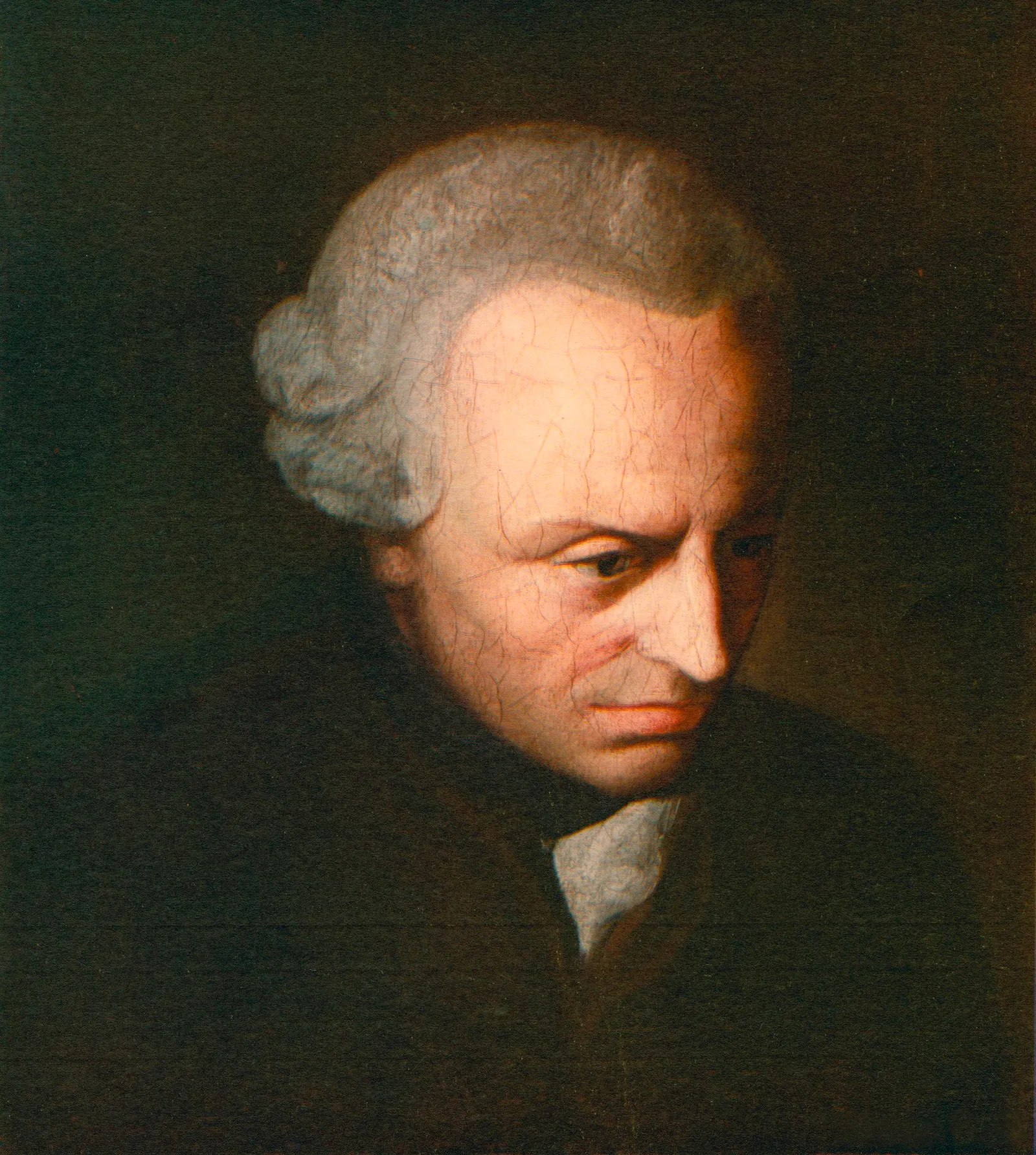
In 1797 “The Metaphysics of Morals” appeared, divided into a Doctrine of Right and a Doctrine of Virtue. While the Doctrine of Virtue deals with inner duties, the Doctrine of Right asks about external freedom: how can many free agents coexist without robbing one another of their freedom? Kant's universal principle of right supplies the formula:
Any action is right if it can coexist with everyone's freedom in accordance with a universal law, or if on its maxim the freedom of choice of each can coexist with everyone's freedom in accordance with a universal law.
Kant, The Metaphysics of Morals (1797), Doctrine of Right, Introduction § C (Ak. 6:230), transl. M. Gregor
Right, then, is not applied morality but the order that makes external freedom compatible under universal laws. For the state this means: a separation of powers is indispensable if it is to be a state under laws of freedom, and the sovereign is the people, whose freedom and equality the constitution must secure — yet Kant rejects any right of resistance by the people against the legislative head of state without exception (Ak. 6:320 f.): even under grave abuse of power only public criticism (complaint) and reform by the state power itself remain — reform from above, never revolt. The Doctrine of Right covers property, punitive justice, the right of states and cosmopolitan right — and it ends where the peace essay began: it contains Kant's most mature statement of the peace project. State, international right and cosmopolitan right form a single edifice of law — perpetual peace is its roof ridge.
Sources: Wikipedia: The Metaphysics of Morals (Doctrine of Right, peace project) · German Wikipedia: Die Metaphysik der Sitten (separation of powers, sovereignty, resistance)
The influence of a philosophical essay of a hundred pages is widely held to reach as far as the founding documents of the United Nations.
Kant's federation did not remain a thought experiment. His ideas fed into British foreign policy under George Canning and Lord Palmerston, and into the American liberal internationalism of Woodrow Wilson's Fourteen Points; in the 1940s, Kant's recommendations were clearly represented in the United Nations. In the study of international relations his sketch stands behind three research programmes at once: democratic peace — democracies hardly ever fight one another, Kant's republic argument in empirical dress; commercial peace — Norman Angell argued in “The Great Illusion” (1909) that modern commerce had made war unprofitable, and Joseph Schumpeter held that capitalism disposes states towards peace; and institutional peace, the pacifying effect of international organisations.
The stages of this influence can be dated precisely. The Covenant of the League of Nations was signed on 28 June 1919 together with the Treaty of Versailles; the League began its work on 10 January 1920. It had no troops of its own, and it had no decisive influence on the run-up to the Second World War. The Charter of the United Nations was signed in San Francisco on 26 June 1945 and came into force on 24 October 1945; it is regarded as substantially inspired by Kant's peace essay. Two of its principles recall Kant's prohibitions: members refrain in their international relations from the threat or use of force (Art. 2(4)), and the organisation may not intervene in matters that are essentially within the domestic jurisdiction of any state (Art. 2(7)). Even so, the United Nations is not a replica of Kant's federation: under Chapter VII the Security Council can decide on enforcement measures, whereas Kant's federation was to do without any common coercive power.
Sources: Wikipedia: League of Nations · German Wikipedia: Völkerbund (Covenant 1919, founding 1920, no troops of its own) · Wikipedia: Charter of the United Nations · German Wikipedia: Charta der Vereinten Nationen (Kant's influence) · UN Charter, Chapter I, Art. 2 (un.org)
The idea kept inspiring new designs: in 1939 Clarence Streit proposed in “Union Now” a federal union of the democracies, modelled on the U.S. Constitution — a project in the tradition of Kant's thinking, though closer to the world state that Kant himself held out only as an idea. Critics have called the sketch an unrealistic ideal that leaves the road to its goal unclear; yet even they concede that its three definitive articles still name the key questions of politics two centuries on. How Kant's ethics lays the foundation for all this is shown in chapter III; what the public use of reason has to do with it, in chapter VI.
Sources: Wikipedia: Perpetual Peace (legacy: Wilson, UN, democratic and commercial peace) · German Wikipedia: Zum ewigen Frieden (reception, criticism)