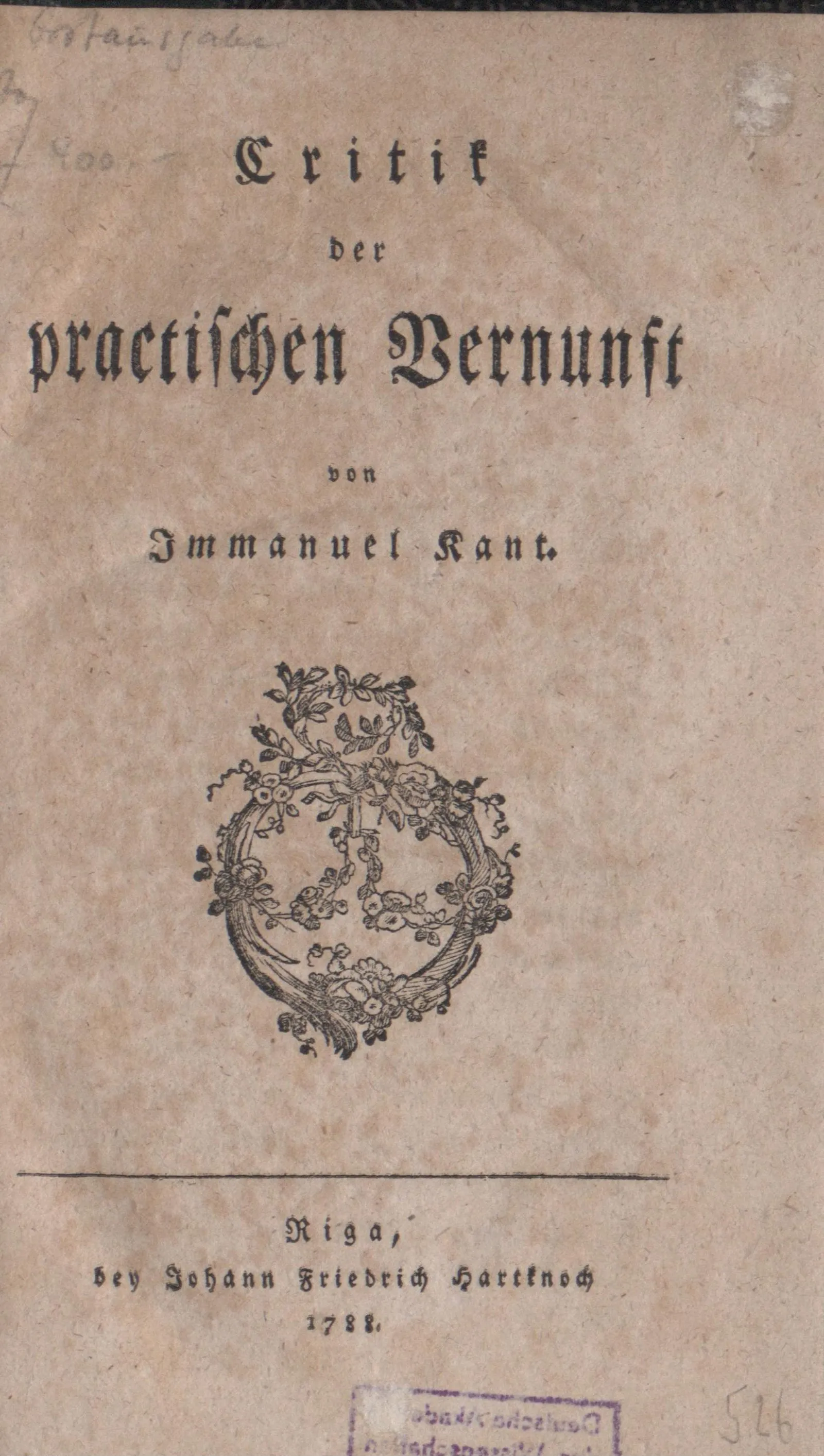
Critique of Practical Reason
The second of the three Critiques is Kant's great answer to the question “What should I do?” — it argues that morality is grounded in pure reason itself, not in feeling, upbringing or belief in God.
Published in 1788 in Riga by Johann Friedrich Hartknoch, the book still counts among the most important works of practical philosophy ever written. Where the Critique of Pure Reason surveys the limits of knowledge, the second Critique shows what remains certain beyond those limits: the moral law — and with it, freedom.
Origin & context
From the Groundwork to a Critique of its own — how the book grew into Kant's system.
Kant had not originally planned a separate critique of practical reason at all: the first Critique was meant to cover the entire faculty of reason, theoretical and practical alike. After the Groundwork of the Metaphysics of Morals of 1785 he reconsidered, at first intending to attach a critique of practical reason as an appendix to the second edition of the Critique of Pure Reason (1787), to answer objections from reviewers — and then decided on an independent book instead, so he could develop his account of the will and anchor ethics firmly within the critical system. The manuscript went to the printers in Halle in June 1787; the book appeared in December 1787 with the year 1788.
The Groundwork and the second Critique belong closely together: both are foundational works that do not yet deliver an applied doctrine of duties, but clarify how moral action can be determined by practical reason in the first place. And the target differs from the first Critique: what needs criticising is not pure practical reason — the moral law is its very product — but empirically practical reason, which tries to base morality on experience, feeling or the pursuit of happiness.
Source: Wikipedia: Critique of Practical Reason (background)
Structure & core ideas
The book mirrors the architecture of the first Critique — a Doctrine of Elements in two parts, followed by a short Doctrine of Method.
- 1Analytic of pure practical reason
Here stands the fundamental law of pure practical reason: “Act in such a way that the maxim of your will could always hold at the same time as a principle of a universal legislation.” The principle is purely formal — it tests only whether a maxim can be universalised. Our consciousness of this law is what Kant calls a “fact of reason”: it cannot be derived from anything else, it simply imposes itself on us, and it is through the moral law that we first come to know our own freedom. The incentive of moral action is respect for the law — a feeling produced by pure reason itself, which humbles our self-love and self-conceit, rather than a sensuous impulse.
- 2Dialectic of pure practical reason
The Dialectic asks about the highest good: virtue combined with a happiness proportionate to it. Because the two do not necessarily coincide in this world, an antinomy of practical reason arises. Kant resolves it through the postulates: freedom, the immortality of the soul and the existence of God — ideas the first Critique could only leave open as thinkable may be assumed as real for the practical standpoint. This is the primacy of practical reason: where theoretical proof fails, practical reason's demands take precedence.
- 3Doctrine of method of pure practical reason
The short concluding part sketches a theory of moral education: how the principles of the moral law can gain entry into the human mind.
Source: Wikipedia: Critique of Practical Reason (contents)
Two things fill the mind with ever new and increasing admiration and reverence, the more often and more steadily one reflects on them: the starry heavens above me and the moral law within me.
Kant, Critique of Practical Reason (1788), Conclusion, Ak. 5:161
The opening of the conclusion
Critique of Practical Reason, Conclusion · Ak. 5:161
Kant's German original
Zwei Dinge erfüllen das Gemüt mit immer neuer und zunehmender Bewunderung und Ehrfurcht, je öfter und anhaltender sich das Nachdenken damit beschäftigt: der bestirnte Himmel über mir und das moralische Gesetz in mir.
The exercise uses our own close translation, which keeps Kant's sentence structure.
Which parts can you leave out without the sentence falling apart? Tap them and they step back. Then check your choice.
Two things fill the mind with ever new and increasing admiration and awe, the more often and the more steadily reflection occupies itself with them: the starry heavens above me and the moral law within me.
Plain words: our paraphrase, not a Kant quotation
Two things amaze me, and the amazement grows rather than shrinks each time I think about them: the starry sky above me and the moral law within me.
The slider unlocks once you have checked your choice.
The frame: Two things fill the mind with admiration and awe: the starry heavens above me and the moral law within me.
Stepping back does not mean unimportant. The additions say how this admiration works: it does not wear off but grows the longer you think about it.
Key words
Once you have checked your choice, the underlined words can be opened.
Tap an underlined word in the sentence.
mind (Gemüt)
- In Kant
- The inner life of a human being as a whole: thinking, feeling and willing, not just a mood.
- In everyday speech
- In German a “sunny Gemüt” is a cheerful nature, and “gemütlich” means cosy.
- Easy to confuse
- It has nothing to do with cosiness. The starry sky “as it were annihilates my importance”, Kant writes right afterwards (Ak. 5:162, our translation).
awe (Ehrfurcht)
- In Kant
- High regard for something greater than oneself. A few lines further on Kant speaks of “admiration and respect” (Ak. 5:162, our translation).
- In everyday speech
- Awe sounds like church, silence and a bowed head.
- Easy to confuse
- Awe here is not fear. According to Kant, the moral law even “raises my worth” (Ak. 5:162, our translation).
moral law (moralisches Gesetz)
- In Kant
- The law that reason gives itself; for us human beings it appears as the categorical imperative.
- In everyday speech
- Laws are made by the state; morals are the rules a society goes by.
- Easy to confuse
- Not a statute book and not a custom: the law is “within me”, not in a legal clause.
Sources: German original (korpora.org): Ak. 5:161 · German original (korpora.org): Ak. 5:162
Legacy & relevance today
From young Fichte's moment of liberation to the reference work of modern ethics.
The impact came quickly: Johann Gottlieb Fichte, who immersed himself in Kant's critical philosophy in 1790, by his own account (letter to Weisshuhn, 1790) credited the second Critique with resolving his crisis over metaphysical determinism — propositions he had thought immovable were overturned, and concepts such as “absolute freedom” and “duty” were now proven to him. From that spark a direct line leads into German idealism.
In the 20th century the book became the principal reference point for deontological — that is, duty-based — moral philosophy and Kantian ethics. In scholarship it is sometimes overshadowed by the more compact Groundwork; the Kant scholar Lewis White Beck argued back in 1960 that it is precisely the second Critique that weaves freedom and practical reason into a comprehensive theory of moral authority.