
Critique of Judgment
Kant's third Critique asks why we call things beautiful or sublime — and why we look at nature as if it were designed for purposes.
Published after the Critique of Pure Reason (1781) and the Critique of Practical Reason (1788), this book completes the critical project. It is meant to close the gap between nature, governed by deterministic laws, and freedom, the domain of morality — and along the way it became a founding text of modern aesthetics.
Source: Wikipedia: Critique of Judgment
Origins & context
Why did the critical system need a third book?
The first two Critiques left Kant with an unresolved tension: the understanding knows nature as a chain of causal determinism, while reason acts from freedom, a spontaneous causality. The Critique of Judgment of 1790 takes on the task of reconciliation. Its key move is to examine judgment itself — the faculty that must operate between these two worlds.
Kant distinguishes two ways of judging. Determinative judgment subsumes a particular case under a universal rule it already possesses. Reflective judgment faces a particular for which the universal is not yet given and has to search for it. Its guiding principle is purposiveness: when we find nature beautiful or see an organism as designed, we are not reading purposes off the things themselves — we are judging them as if they were purposive, because that is how our cognition must approach them.
A detail of the book's textual history fits this struggle: Kant wrote a substantial First Introduction but withheld it, replacing it with a different introduction for publication — a sign of how hard he worked to fix the place of this third Critique within his system.
Source: Wikipedia: Critique of Judgment (context and structure)
Structure & core ideas
Two parts, one principle: purposiveness — first aesthetic, then teleological.
- The beautiful
- Kant analyses the judgment of taste in four moments: it is subjective in quality, yet claims universal validity; its object shows “purposiveness without purpose” — it looks designed although it serves no practical function — and it demands the assent of others. The pleasure arises from a free play between imagination and understanding.
- Free and adherent beauty
- A pure judgment of taste needs no concept of what the object is — ornamental patterns please freely. Adherent beauty is different: to find a horse well-formed and beautiful, you must already know what a horse is supposed to be.
- The sublime
- The sublime concerns what exceeds our grasp: the mathematically sublime overwhelms us by sheer vastness, the dynamically sublime by power — nature deserving of fear, contemplated without actual threat.
- Genius and teleology
- While taste judges beauty, genius produces it. The second part turns to organisms: living beings cannot be adequately explained by mechanism alone, so we must judge them as if they were teleological — a reflection of our cognitive limits, not a claim about reality. Humanity, capable of reason and morality, figures as nature's ultimate end, with culture as its highest expression.
Source: Wikipedia: Critique of Judgment (aesthetic and teleological judgment)
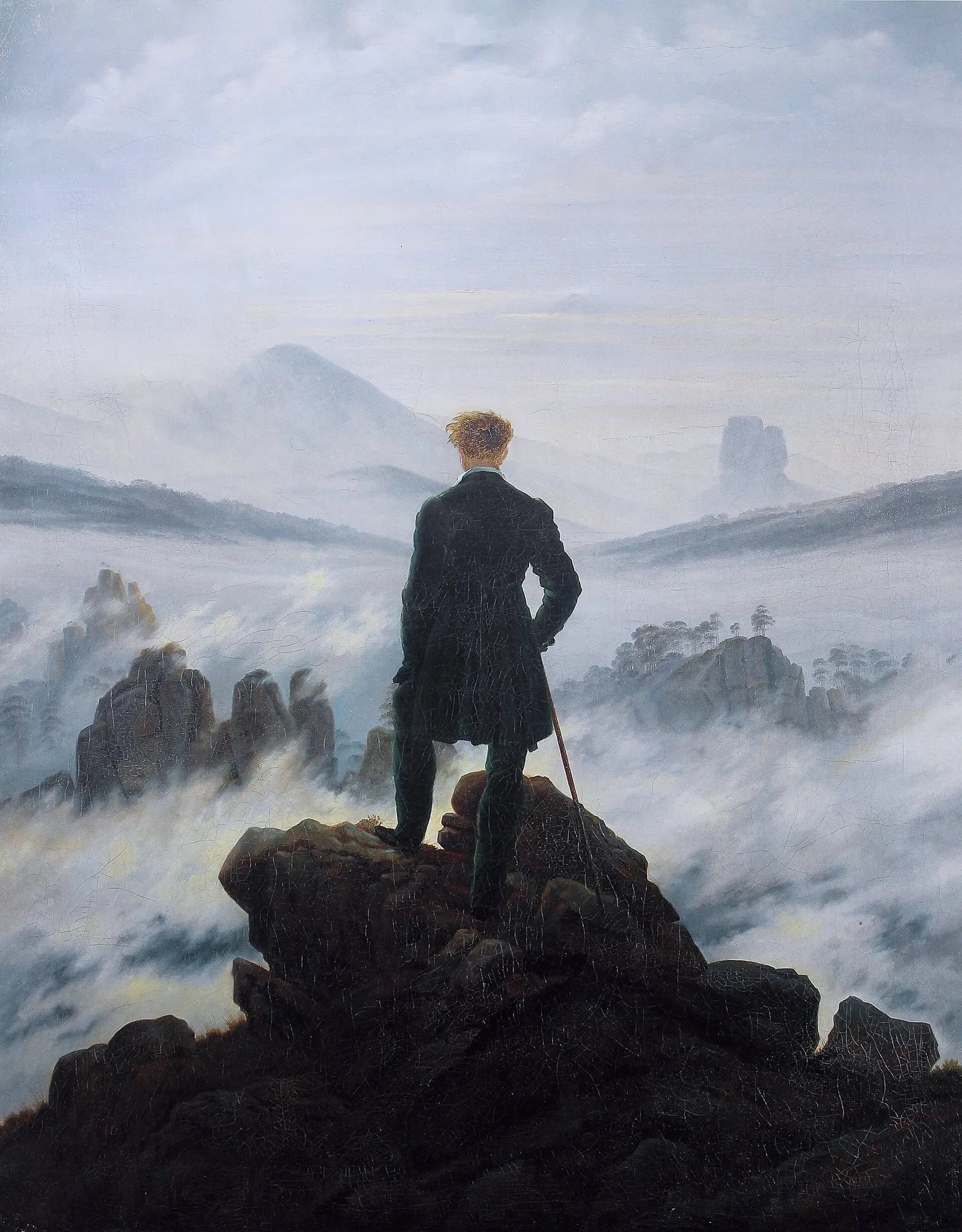
Source: Wikipedia: Critique of Judgment (teleology)
The definition of the beautiful
Critique of Judgment, § 5 · Ak. 5:211
Kant's German original
Geschmack ist das Beurteilungsvermögen eines Gegenstandes oder einer Vorstellungsart durch ein Wohlgefallen oder Missfallen ohne alles Interesse. Der Gegenstand eines solchen Wohlgefallens heißt schön.
The exercise uses our own close translation, which keeps Kant's sentence structure.
Which parts can you leave out without the sentence falling apart? Tap them and they step back. Then check your choice.
Taste is the faculty of judging an object or a way of representing it through a liking or disliking without any interest. The object of such a liking is called beautiful.
Plain words: our paraphrase, not a Kant quotation
Finding something beautiful means: it pleases me without my wanting to own, use or consume it. And because my pleasure depends on nothing personal, I expect that it ought to please others too.
The slider unlocks once you have checked your choice.
The frame: Taste is the faculty of judging an object through a liking without any interest. The object of such a liking is called beautiful.
Stepping back does not mean unimportant. The additions make the definition complete: taste also judges the way something is represented, and it can also reject.
Key words
Once you have checked your choice, the underlined words can be opened.
Tap an underlined word in the sentence.
taste (Geschmack)
- In Kant
- The faculty of judging the beautiful. Whoever calls something beautiful judges, according to Kant, “not merely for himself but for everyone” (Ak. 5:212, our translation).
- In everyday speech
- “A matter of taste”: there is no arguing about what people like.
- Easy to confuse
- Kant grants this for what is merely agreeable: “everyone has his own taste (of the senses)”. With the beautiful, he says, “it is quite different” (Ak. 5:212, our translation).
liking (Wohlgefallen)
- In Kant
- Pleasure in something: the feeling bound up with a judgment about the beautiful.
- In everyday speech
- Sounds old-fashioned in German, as in “to everyone's satisfaction”.
- Easy to confuse
- Not the applause of the majority, but a feeling in the individual, which he does, however, “expect of” others (Ak. 5:212, our translation).
interest (Interesse)
- In Kant
- “The liking that we connect with the representation of the existence of an object is called interest” (Ak. 5:204, our translation): you want to own, use or consume the thing.
- In everyday speech
- Interest means curiosity or attention: “That interests me.”
- Easy to confuse
- “Without interest” does not mean bored. It means: for the judgment “beautiful” it does not matter whether the thing is mine or useful to me. Kant's example is a palace (Ak. 5:204).
Sources: German original (korpora.org): Ak. 5:211 · German original (korpora.org): Ak. 5:204 · German original (korpora.org): Ak. 5:212
Legacy & relevance today
From German Idealism to twentieth-century continental philosophy.
The third Critique became a quarry for the generation after Kant. Fichte and Schelling read its idea of an intuitive understanding as suggesting that the mind creates its phenomena — an interpretation Kant himself rejected, but one that profoundly shaped German Idealism. Schopenhauer, more critical, noted that Kant had analysed the judgment about beauty rather than the experience of beauty itself.
The book's influence reaches deep into the twentieth century. Hans-Georg Gadamer built his hermeneutics in Truth and Method (1960) partly against what he saw as the ahistorical character of Kantian aesthetics, while Jacques Derrida studied Kant's treatment of schema and symbol — discussions that became foundational for late continental thought. Meanwhile the core aesthetic insight endures: beauty is neither a measurable property of things nor mere private preference, but a subjective judgment that still claims validity for everyone.