What can I know?
Kant's first great question — and the question that split the philosophy of his age. His answer is the “Critique of Pure Reason”, the book that divides the history of philosophy into a before and an after.
Where does our knowledge come from — and how far does it reach? Over this core question of epistemology, two camps faced each other in the eighteenth century. The rationalists in the tradition of Descartes and Leibniz trusted reason: secure knowledge is reached by logical inference from clear concepts, on the model of mathematics. The empiricists around Locke, Berkeley and Hume objected: all knowledge comes from experience — whatever does not enter through the senses is empty speculation.
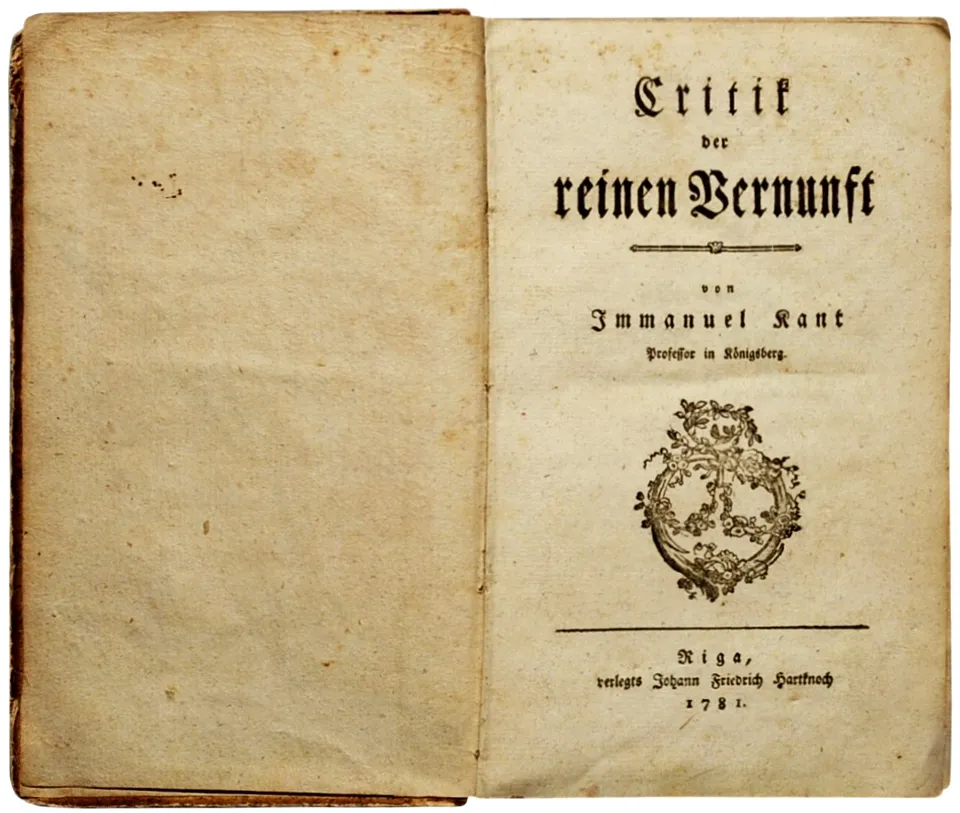
It was David Hume who delivered the decisive blow to both camps. He showed that no amount of experience can ever prove that an effect must follow its cause — we only ever observe events succeeding one another, never the necessity itself. The objection struck Kant to the core. The remembrance of Hume, he later wrote in the “Prolegomena” (1783, Ak. 4:260), “first interrupted my dogmatic slumber” and gave his investigations “a completely different direction”. He worked on his answer for more than a decade; in 1781 the “Critique of Pure Reason” appeared with the publisher Johann Friedrich Hartknoch, followed in 1787 by the heavily revised second edition.
Sources: Wikipedia: Critique of Pure Reason · Wikipedia: Epistemology · Kant, Prolegomena (1783), Ak. 4:260 (quotations in own translation)
The Copernican revolution
In the preface to the second edition, Kant compares his move to that of Copernicus, who stopped letting the stars circle the spectator and instead set the spectator in motion.
Copernican planetarium
Throw the lever and look at both assumptions.
Knowledge must conform to its objects.
As before Copernicus: the whole host of stars turns around the spectator, who stands still.
Applied to knowing: we only receive what things show us. Then it remains a mystery how we could know anything about them before we experience them.
Your answer appears here once you have chosen.
“Let us therefore try for once whether we do not get further with the problems of metaphysics by assuming that objects must conform to our knowledge”
Critique of Pure Reason, preface B XVI (Ak. 3:12), own translation
Kant explicitly speaks of an attempt: he tests the reversal like a hypothesis, just as Copernicus did with the heavens.
Bertrand Russell found the comparison misleading: Copernicus had moved humans out of the centre of the world, and Kant put them back in. He called it a “Ptolemaic counter-revolution”.
Bertrand Russell, Human Knowledge: Its Scope and Limits (1948), Introduction
And the thing in itself? If everything that appears to us conforms to our forms, one question remains: what are things independently of that, in themselves?
Kant's answer: We can think them, but we cannot know them. Kant insists “that we must at least be able to think these same objects also as things in themselves, even if we cannot know them” (B XXVI, Ak. 3:17, own translation).
For the curious
Kant's contemporary Friedrich Heinrich Jacobi already spotted a snag here. Roughly: without the thing in itself you cannot enter Kant's system, and with it you cannot stay inside. For how can something we cannot know affect our senses, if “cause” applies only to appearances?
Sources: Kant, Critique of Pure Reason, Ak. 3:12 (in German) · Ak. 3:17 · Wikipedia: Copernican Revolution (metaphorical usage) · Russell, Human Knowledge (1948), Introduction (archive.org) · Wikipedia: Thing-in-itself · Wikipedia (in German): Kopernikanische Wende
- 1The old model: knowledge must conform to objects
The mind was taken to be a passive mirror of a ready-made world. Yet on this assumption, Kant diagnoses, every attempt to establish anything about objects a priori — ahead of all experience — had ended in failure. Metaphysics had been treading water for centuries.
- 2Kant's inversion: objects must conform to our knowledge
Kant reverses the relation — experimentally, like Copernicus. The mind is not a mirror but an architect: space, time and the categories of the understanding are forms that we bring to everything we encounter. Experience is always already shaped by them.
- 3The consequence: secure knowledge — but only of appearances
The conditions of our knowledge are at the same time the conditions of the objects of knowledge. That is why strict a priori knowledge is possible, in mathematics and physics for instance — but it holds only for the world as it appears to us, never for things as they are in themselves.
NoteAn experiment in the other direction
… that we assume objects must conform to our cognition …
Reference: Critique of Pure Reason, preface to the 2nd edition (B xvi), Ak. 3:12 · Read the original
Kant puts it as an experiment, not as a claim, and on the same page compares it with Copernicus, who let the observer revolve instead of the starry heavens.
Translation: Our own translation of the German original.
New in your logbook · See the collection
Source: Wikipedia: Critique of Pure Reason (preface B, Copernican revolution)
Four ways of judging
Before Kant can pose his guiding question, he sorts knowledge itself — with two distinctions that cross each other.
- Analytic
- The predicate is already contained in the concept of the subject — the judgment merely unpacks what was thought all along. Kant's example: “All bodies are extended.” Such judgments are always true, but they teach us nothing new.
- Synthetic
- The predicate adds something to the concept that was not contained in it — the judgment extends our knowledge. “All bodies are heavy” joins two ideas that are not wrapped up in one another.
- A priori
- Valid independently of all experience — recognisable by necessity and strict universality: no exception is possible.
- A posteriori
- Drawn from experience — useful, but never necessary: the next observation might turn out differently.
The interesting part is where the two pairs cross. Analytic a priori judgments are trivial, synthetic a posteriori ones are everyday fare. But are there synthetic a priori judgments — statements that extend our knowledge and hold necessarily? Kant says yes, right in the middle of mathematics. In “7 + 5 = 12”, no analysis of seven, five or the concept of a sum will ever yield the twelve — and yet the proposition admits of no exception.
NoteSeven plus five
The arithmetical proposition is therefore always synthetic …
Reference: Critique of Pure Reason (B 16), Ak. 3:37 · Read the original
The concept “sum of 7 and 5” does not yet contain the twelve, Kant says: you have to build it first, with your fingers for instance. That is why he holds arithmetic to be synthetic and yet a priori.
Translation: Our own translation of the German original.
New in your logbook · See the collection
Source: Wikipedia: Critique of Pure Reason (analytic–synthetic distinction, 7 + 5 = 12)
Try it: the judgment lab
Analytic or synthetic? A priori or a posteriori? The best way to grasp Kant's distinctions is to do the sorting yourself.
First test each sample judgment with two lenses, then assign it to the category where Kant would place it. After every answer you get the solution with an explanation. Kant's most famous example awaits you at the end.
Judgment lab
Sentence 1 of 6
“All bodies are extended.”
Test the sentence with both lenses. The field they point to lights up. You can also tap a field directly.
Boss fight: 7 + 5 = 12
Kant's most famous example. Even he admits:
“One might at first think that the proposition 7 + 5 = 12 is a merely analytic proposition”
B 15 (Ak. 3:37), own translation
Add your five fingers to the seven dots, one at a time.
7 + 0 = 7
Round 3: So where does the sentence belong?
Defeated.
“The arithmetical proposition is therefore always synthetic”
B 16 (Ak. 3:37), own translation
For the curious: is 7 + 5 = 12 really synthetic?
In “The Foundations of Arithmetic” (1884), Gottlob Frege set out to show that arithmetic can be reduced to logic; then Kant's arithmetical truths would be analytic, not synthetic (logicism). Frege's system ran into trouble in 1902 with Russell's paradox. Whether arithmetic is synthetic a priori is still debated today.
Sources: Wikipedia: Gottlob Frege · Wikipedia: Logicism
This instrument needs JavaScript. Here is the answer to read:
- “All bodies are extended.” – analytic a priori. Kant's own example: the predicate “extended” is already contained in the concept of a body — the judgment merely analyses the concept (analytic) and needs no experience (a priori). (CPR, Introduction)
- “7 + 5 = 12” – synthetic a priori. Kant's most famous example: “12” is not contained in the concept of “7 + 5” — the judgment extends our knowledge (synthetic), yet holds necessarily and independently of experience (a priori). (CPR, Introduction)
- “All bodies are heavy.” – synthetic a posteriori. Also Kant's: “heaviness” is not part of the concept of a body (synthetic), and we know it only from experience (a posteriori). (CPR, Introduction)
- “The straight line is the shortest connection between two points.” – synthetic a priori. Kant's geometry example: “shortest” is a concept of magnitude not contained in the concept of straightness — synthetic, yet necessarily true: a priori. (CPR, Introduction)
- “All bachelors are unmarried.” – analytic a priori. The classic textbook case of an analytic a priori judgment: “unmarried” is part of the definition of “bachelor”. (cf. CPR)
- “This rose is red.” – synthetic a posteriori. A judgment of perception: it extends the concept (synthetic) and rests on experience alone (a posteriori). (cf. CPR)
- “Everything that happens has a cause.” – synthetic a priori. For Kant the model case of metaphysics: synthetic (the cause is not contained in the concept of an event) yet a priori — a principle that first makes experience possible. Note that, for Kant, analytic a posteriori judgments do not exist at all. (CPR, Introduction)
Source: Wikipedia: Critique of Pure Reason (classification of judgments)
Space, time — and the twelve categories
For Kant, knowledge has two stems: sensibility, which receives intuitions, and the understanding, which contributes concepts.
Thinking space away
An experiment in your head. The drawing plays along as long as it can.
- The apple has lost its colour. That was easy.
- The apple is gone. That worked too.
- No thing is left. What remains is empty space.
This is where the drawing stops: a picture can only show what is somewhere. Close your eyes for a moment and now think away the empty space itself.
Your answer appears here once you have chosen.
“One can never form a representation of there being no space, although one can quite well think that no objects are to be found in it.”
Critique of Pure Reason, A 24/B 38 f. (Ak. 3:52), own translation
Kant concludes: space is not something we find in things. It is the form in which we intuit anything outside us in the first place.
Gottfried Wilhelm Leibniz saw it the other way round: space is the order of things that exist at the same time. Think all things away and no order is left, and so no space either.
Kant's answer: Space is a form of our intuition: it already underlies every representation of something outside us. For Kant, space is “a necessary representation a priori which underlies all outer intuitions” (Ak. 3:52, own translation).
Sources: Kant, Critique of Pure Reason, Ak. 3:52 (in German) · Wikipedia: Transcendental idealism · Wikipedia: Leibniz–Clarke correspondence
The first stem is examined in the Transcendental Aesthetic. Its result: space and time are neither properties of things themselves nor concepts abstracted from experience. They are pure a priori forms of intuition — the glasses we can never take off. We can think everything out of space, but never space itself; there is only ever one space and one time; their parts are merely limitations of this one whole. This is exactly why geometry is possible: it spells out with necessity what lies in the pure intuition of space — and even “7 + 5 = 12” rests on the succession given in time.
The second stem is the understanding. While sensibility merely receives impressions, the understanding combines them spontaneously — concepts, Kant says, rest on the spontaneity of thought as intuitions rest on the receptivity of impressions. This ordering follows twelve root concepts, the categories, which Kant arranges in four groups of three:
- Quantity
- Unity, plurality, totality — we grasp every object as one, as many, or as all.
- Quality
- Reality, negation, limitation — something is, is not, or is bounded.
- Relation
- Substance and accident, cause and effect, reciprocity — here sits the reply to Hume: causality is a form of the understanding.
- Modality
- Possibility, existence, necessity — together with their counterparts impossibility, non-existence, contingency.
With that, Kant takes Hume's problem to be solved — in a surprising way. Causality is not a feature we would have to coax out of the world; it is a condition without which we would have no ordered experience at all. It holds necessarily for everything we can experience — because it belongs to the equipment of the experiencer.
Source: Wikipedia: Critique of Pure Reason (Transcendental Aesthetic and Analytic, table of categories)
The knowledge machine: empty and blind
What happens when one of the two faculties is missing? Kant has a famous answer.
For Kant, all knowledge needs both: sensibility supplies intuitions, and the understanding thinks them under concepts. If either is missing, no object arises. Concepts without anything to refer to remain empty; intuitions without concepts yield nothing that could be recognised as this or that thing. Kant sums it up in the sentence that thoughts without content are empty and intuitions without concepts are blind.
A young writer who had just come across “the newer so-called Kantian philosophy” (own translation) understood this in his own way in 1801. Heinrich von Kleist wrote to his fiancée Wilhelmine von Zenge that the understanding was like having green glasses instead of eyes: everything would look green. He concluded that we could never decide whether our truth is really truth. How deeply Kant actually shook him is disputed among Kleist scholars.
The knowledge machine
Switch the three parts on and off one at a time. Find three states: empty, blind and a scene.
Nothing comes in, and nothing is thought.
Found: empty blind scene
In 1801 Heinrich von Kleist, who had just become acquainted with “the newer so-called Kantian philosophy” (own translation), reached for exactly such an image:
“If all people had green glasses instead of eyes, they would have to judge that the objects they see through them are green – and they could never decide whether their eye shows them things as they are, or whether it adds something to them that belongs not to them but to the eye. So it is with the understanding.”
Kleist to Wilhelmine von Zenge, Berlin, 22 March 1801, own translation
Your answer appears here once you have chosen.
“Without sensibility no object would be given to us, and without understanding none would be thought. Thoughts without content are empty, intuitions without concepts are blind.”
Critique of Pure Reason, A 51/B 75 (Ak. 3:75), own translation
For Kant, sensibility includes sensations and their forms, space and time, so in the machine it takes two switches. Only when sensibility and understanding work together does an object arise that can be known.
For empiricists like John Locke, the understanding brings no forms of its own: at birth the mind is a blank slate, and only experience writes on it.
Sources: Kant, Critique of Pure Reason, Ak. 3:75 (in German) · Kleist, letters of 1801 (Projekt Gutenberg, in German) · Wikipedia (in German): Heinrich von Kleist · Wikipedia: John Locke
Sources: Kant, Critique of Pure Reason, Ak. 3:75 (in German) · Kleist, letters of 1801 (Projekt Gutenberg, in German) · Wikipedia (in German): Heinrich von Kleist
Hume's billiards
One ball strikes another. What exactly do you see?
David Hume chose an example from the billiard table: one ball rolls towards another, touches it, and the second starts to move. All you see is that one thing follows the other; a necessary connection, a causing, is nowhere to be seen. That we are nevertheless sure about the next shot, Hume explained by custom.
Kant took the objection seriously but drew a different conclusion. Precisely because the concept of cause demands strict necessity, it cannot come from mere repetition. It belongs to the categories that the understanding brings along, and so it holds for everything we can experience at all. Which cause has which effect, however, we learn even according to Kant only from experience.
Hume's billiards
Look for the cause: you only find positions one after another, nowhere a separate image of causing.
Hume sees exactly this: one event follows another, but a necessary connection is never seen. That we nevertheless expect it with confidence comes from habit. The more often you see the shot, the stronger the expectation, but not its justification.
“Custom, then, is the great guide of human life.”
David Hume, An Enquiry Concerning Human Understanding (1748), section V, § 36
Kant agrees with Hume that necessity cannot be seen. But he turns the conclusion around: because the concept of cause contains strict necessity, it cannot come from repetition. It is a category that the understanding brings along, and so it holds for everything we can experience.
Your answer appears here once you have chosen.
“… the very concept of a cause so manifestly contains the concept of a necessary connection with an effect and of a strict universality of the rule that it would be lost entirely …”
Critique of Pure Reason, B 5 (Ak. 3:29), own translation
In substance he goes on: it would be lost if one tried, like Hume, to derive it from habit.
Hume had already argued, before Kant, that reason decides nothing here. At the billiard table he asks:
“may I not conceive, that a hundred different events might as well follow from that cause?”
Hume, An Enquiry Concerning Human Understanding, section IV, § 25
Sources: Hume, An Enquiry Concerning Human Understanding (Project Gutenberg) · Kant, Critique of Pure Reason, Ak. 3:29 (in German) · Wikipedia: An Enquiry Concerning Human Understanding
Sources: Hume, An Enquiry Concerning Human Understanding (1748), IV § 25, V § 36 · Kant, Critique of Pure Reason, Ak. 3:29 (in German) · Wikipedia: An Enquiry Concerning Human Understanding
Appearance, thing in itself — the limits of metaphysics
The price of the Copernican revolution: what things are independently of our knowledge remains forever hidden.
What we know is the world as appearance (phenomenon) — shaped by space, time and the categories. The thing in itself (noumenon), by contrast, is empty as an object of knowledge: from the understanding alone, without intuition, we gain no knowledge whatsoever. The concept remains a boundary concept — it marks what we can speak about without ever knowing it. The two faculties depend on each other; neither yields knowledge on its own:
Thoughts without content are empty, intuitions without concepts are blind.
Kant, Critique of Pure Reason (1781/1787), A 51/B 75 — own translation
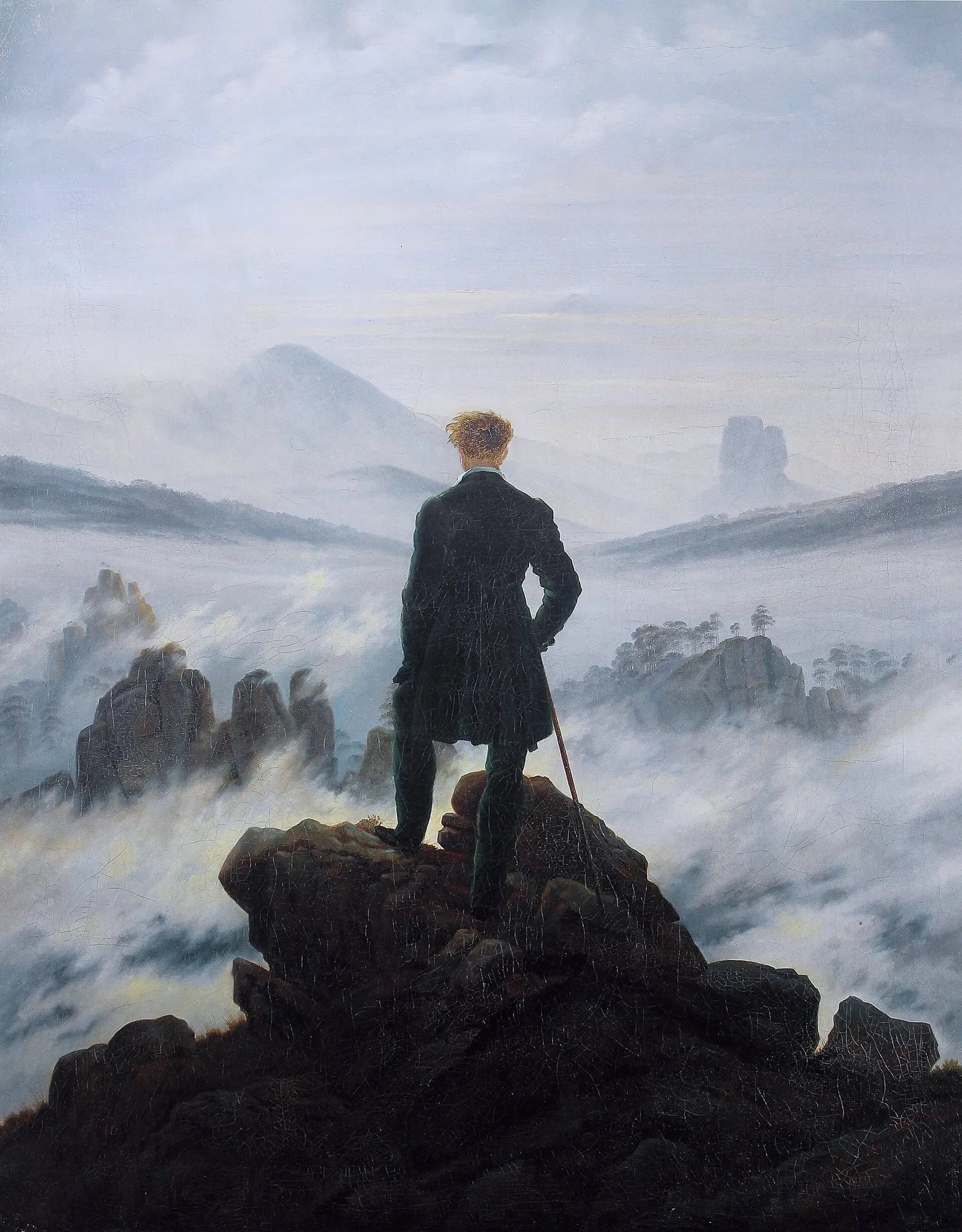
At this boundary the old metaphysics founders — systematically so, as the Transcendental Dialectic shows. As soon as reason leaves the world of experience, it entangles itself in illusory inferences: from the “I think” it conjures an immortal soul-substance (the paralogisms); about the world as a whole it proves opposites with equal conviction — for instance that the world has a beginning and that it has none (the antinomies, which Kant, however, resolves through the distinction between appearance and thing in itself); and Kant dismantles the classical proofs of God's existence piece by piece, since existence is not a predicate that could be extracted from a mere concept.
Does that finish off God, freedom and immortality? No — they simply cannot be objects of knowledge. As regulative ideas they keep their right: they guide inquiry and conduct, like fixed points on the horizon. Precisely because knowledge ends here, room remains for hope and morality — the thread that Kant's ethics picks up.
Source: Wikipedia: Critique of Pure Reason (Transcendental Dialectic, regulative ideas)
The court of the antinomies
Does the world have a beginning? Kant lets both answers compete.
In the Transcendental Dialectic, Kant sets out four conflicts in which reason seems to have equally good proofs for a claim and for its opposite. The first concerns the beginning and limits of the world. The thesis says: the world has a beginning in time. The antithesis says: it has none. Kant writes down both proofs himself, side by side.
His resolution: both parties silently assume that the world as a whole is a ready-made thing in itself. But the world we experience is appearance and is never given as a completed whole; that is why it exists neither as a finite nor as an infinite whole. That reason contradicts itself here shows, for Kant, that it has overstepped the limit of possible experience.
Court of the antinomies
Scales: how much each side convinces you
Proofs simplified after Kant
Thesis
“The world has a beginning in time and is also enclosed within limits as regards space.”
B 454 (Ak. 3:294), own translation
- Suppose the world had no beginning. Then an eternity would already have passed up to today: an infinite series of states, one after another.
- But an infinite series can never be completed step by step. That is exactly what “infinite” means.
- Yet up to today the series has run its course. So it was not infinite: the world must have a beginning.
Antithesis
“The world has no beginning and no limits in space, but is infinite as regards both time and space.”
B 455 (Ak. 3:295), own translation
- Suppose the world had a beginning. Then a time preceded it in which the world was not: an empty time.
- But in an empty time no moment differs from any other. Nothing in it could bring it about that something arises right now and not earlier.
- So many things within the world can begin, but the world itself cannot: it has no beginning.
Kant wrote down both proofs himself, side by side. Each refutes the other side, and each seems to hold. How can that be?
Kant's answer: Both lose: they treat the world as a whole like a ready-made thing in itself. As appearance, though, it is never given as a whole. This is how Kant resolves the conflict: the world exists “neither as an in itself infinite nor as an in itself finite whole” (Ak. 3:347, own translation).
Your answer appears here once you have chosen.
“If one regards the two propositions, the world is infinite in magnitude, the world is finite in magnitude, as contradictory opposites, one assumes that the world (the whole series of appearances) is a thing in itself.”
Critique of Pure Reason, B 532 (Ak. 3:346), own translation
When reason falls into conflict with itself like this, for Kant it is a sign that it has overstepped the limit of possible experience.
Arthur Schopenhauer considered the whole antinomy “a mere delusion, a sham fight” (Haldane/Kemp translation): the proofs of the thesis were sophisms, and only the antithesis followed necessarily from the laws of the world of appearances. Then the scales were never balanced.
Sources: Kant, Critique of Pure Reason, Ak. 3:294 f. (in German) · Ak. 3:346 f. (in German) · Wikipedia: Kant's antinomies · Schopenhauer, Criticism of the Kantian Philosophy (Project Gutenberg) · Wikipedia: Critique of the Kantian Philosophy
Sources: Kant, Critique of Pure Reason, Ak. 3:294 f. (in German) · Ak. 3:346 f. (in German) · Wikipedia: Kant's antinomies
Case file: The hundred thalers
Can you prove from a mere concept that something exists?
The ontological proof of God tries to infer from the mere concept of God that God exists. Anselm of Canterbury built it on “that than which nothing greater can be conceived”, René Descartes on the most perfect being, which could not lack existence. It was Kant who first called the proof “ontological”.
Kant's objection: “being” is not a feature that is added to a concept; it merely posits the object with all its features. His example is a hundred thalers. Imagined and real thalers have the same concept; what differs is only what you then have in your purse.
The hundred thalers
The ontological proof of God
Game format: the case file is invented, the argument is real (after Descartes, much simplified).
Mark the line where Kant raises his objection.
Kant's answer: 2. This is where Kant objects: this line treats “existence” like a property that can be added to a concept. Being is not a real predicate: “is” adds nothing to the concept, it merely posits the object with all its features.
A hundred imagined thalers
- In the concept
- 100
- In your purse
- 0
A hundred real thalers
- In the concept
- 100
- In your purse
- 100
The concept is the same both times: a hundred thalers. What changes is not the concept but your situation.
Your answer appears here once you have chosen.
“Being is obviously not a real predicate, that is, a concept of something that could be added to the concept of a thing. […] A hundred real thalers do not contain the least bit more than a hundred possible ones.”
Critique of Pure Reason, B 626 f. (Ak. 3:401), own translation
And yet, Kant goes on, “in my financial state there is more with a hundred real thalers than with the mere concept of them” (own translation).
Georg Wilhelm Friedrich Hegel thought the thaler example was skewed: a hundred thalers are a finite, contingent thing, whereas God would be not one thing among many but the necessary whole. More recent versions of the argument (Norman Malcolm, Alvin Plantinga) work with modal logic; whether Kant's objection reaches them is disputed.
Sources: Kant, Critique of Pure Reason, Ak. 3:401 (in German) · Wikipedia: Ontological argument
NoteA hundred thalers
A hundred real thalers do not contain the least bit more than a hundred possible ones.
Reference: Critique of Pure Reason (B 627), Ak. 3:401 · Read the original
Kant aims this at the ontological proof of God: “being” adds no property to a concept. In your purse the difference is plain all the same, as he himself remarks straight afterwards.
Translation: Our own translation of the German original.
New in your logbook · See the collection
Sources: Kant, Critique of Pure Reason, Ak. 3:401 (in German) · Wikipedia: Ontological argument
A before and an after
Few books have changed philosophy as profoundly as the Critique of Pure Reason.
At first the difficult work met with silence. But through the “Prolegomena” (1783), Reinhold's “Letters on the Kantian Philosophy” (1786/87) and the second edition of 1787, Kant became the leading and most debated philosopher of his time. Moses Mendelssohn called him the “all-crushing” Kant — for his critique of traditional metaphysics, which includes the proofs of God; the Catholic Church placed the book on its Index of Forbidden Books in 1827. At the same time it became the founding text of German idealism — Fichte, Schelling, Hegel — and later the reference point of Neo-Kantianism.
NoteGreen glasses
If all people had green glasses instead of eyes, they would have to judge that the objects they see through them are green …
Reference: Heinrich von Kleist to Wilhelmine von Zenge, Berlin, 22 March 1801 · Source
Kleist had, as he writes, “become acquainted with the newer so-called Kantian philosophy” and concluded that no truth was certain. The thought had shaken him “so deeply, so painfully”, he wrote. How far Kant really caused his crisis is disputed among Kleist scholars; the term “Kant crisis” is considered questionable there.
What the image leaves out: Kleist's glasses sit “instead of the eyes”: they can no more be taken off than Kant's forms of intuition and concepts of the understanding. The difference lies in the conclusion: for Kant our knowledge of appearances is genuinely true; it just does not reach things as they are in themselves.
Translation: Our own translation of the German original.
New in your logbook · See the collection
Sources: Wikipedia: Critique of Pure Reason (reception and influence) · Wikipedia: Immanuel Kant · Mendelssohn, Morgenstunden (1785), preface (in German)
Next comes the second question — “What should I do?” — in Chapter III · Ethics.