What is Enlightenment?
In 1783 a footnote in a Berlin journal asked a deceptively simple question — and Kant's answer became the manifesto of an entire epoch.
The story begins with a quarrel about marriage. In September 1783 Johann Erich Biester, co-editor of the Berlinische Monatsschrift (Berlin Monthly), published a proposal to stop involving the clergy in the conduct of marriages. The Berlin clergyman Johann Friedrich Zöllner objected — and in a footnote to his reply he dropped, almost in passing, the question: “What is enlightenment?” Everyone had been talking about enlightenment for decades, he noted, yet nobody had clearly said what it actually was.
The footnote turned into the burning question of the age. Several leading minds sent answers to the journal — but the one that made history came from Königsberg: the December 1784 issue carried Kant's “Answering the Question: What Is Enlightenment?”, today among the most famous texts of the German Enlightenment.
Source: Wikipedia: Answering the Question: What Is Enlightenment?
The famous definition
Kant does not waste a line: the essay opens with the definition that became the epoch's best-known passage.
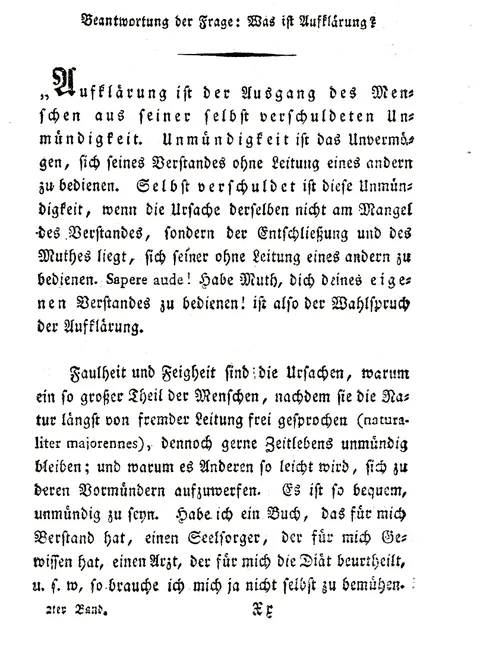
Enlightenment is man's release from his self-incurred tutelage. Tutelage is man's inability to make use of his understanding without direction from another. Self-incurred is this tutelage when its cause lies not in lack of reason but in lack of resolution and courage to use it without direction from another. Sapere aude! “Have courage to use your own reason!” – that is the motto of enlightenment.
Kant, Answering the Question: What Is Enlightenment? (1784), Ak. 8:35, transl. L. W. Beck
Every word here is load-bearing. Enlightenment, for Kant, is not a state or a possession but an exit, a release — a movement each person has to make for themselves. And the obstacle is not out there; it is in us:
- 1Immaturity (tutelage)
Immature is whoever cannot use their own understanding without someone else's guidance — like a child, with others deciding on their behalf. The capacity to think is not missing; it simply goes unused.
- 2Self-incurred
That is exactly why this immaturity is self-incurred: its cause is not a “lack of reason” but a lack of resolution and courage to use one's reason. If you could think for yourself but let others do it, the responsibility is yours.
- 3Laziness and cowardice
“Laziness and cowardice” are Kant's blunt diagnosis of why so many people gladly remain immature for life — and why it is so easy for others to set themselves up as their guardians. Being immature is comfortable: a book that understands for me, a pastor who has a conscience for me, a physician who decides my diet — and the irksome work of thinking is taken care of.
- 4Sapere aude!
The motto of enlightenment is therefore an appeal to courage, not to intelligence: “Have courage to use your own reason!” Enlightenment does not begin with more knowledge but with the decision to judge for oneself.
Sources: Wikipedia: Answering the Question: What Is Enlightenment? · Full text of the essay on Wikisource
Out of the go-cart
For comfortable immaturity Kant chooses an image from the nursery.
A Gängelwagen, or go-cart, was a wheeled frame in which small children were meant to learn to walk. In German, “gängeln” originally meant simply “to guide someone as they walk”; the word only took on its disparaging sound in the 18th century. Kant turns it into a sharp image: the guardians, he says, first made their “domestic cattle” dumb and carefully prevented these placid creatures from daring a single step outside the go-cart in which they had shut them. Then they showed them the danger that threatens if they try to walk alone.
Now this danger is in fact not so great, for after falling a few times they would surely learn to walk in the end; but an example of this kind makes them timid and usually frightens them off from all further attempts.
Kant, What Is Enlightenment? (1784), Ak. 8:35 f., own translation
Kant's guardians are not tyrants but comfortable helpers: a book, a pastor, a doctor. “I need not think, so long as I can pay; others will readily take over the tiresome business for me.” The real fetters, for Kant, are “statutes and formulas”, the “shackles of a permanent immaturity”: whoever threw them off would still make “only an uncertain leap” over even the narrowest ditch, because he is not used to such free movement. Which helpers these would be today, the text of 1784 naturally does not say. Satnav, search engine and AI are our transfer, and whether they are guardians or tools is an open question.
The straps of the go-cart
Satnav, search engine, AI: do helpers like these keep you immature?
Your verdict is saved. Now the straps.
The go-cart stands still. All six straps hold.
Six helpers hold you by straps: three from Kant's text, three from today. For each strap, decide whether you untie it and check for yourself, or rely on it. There is no right or wrong here.
Without JavaScript the straps cannot be untied; Kant's answer and the opposing voice are below.
-
Book “that has understanding for me” Kant, Ak. 8:35, own translation
-
Pastor “who has a conscience for me” Kant, Ak. 8:35, own translation
-
Doctor “who judges my diet for me” Kant, Ak. 8:35, own translation
-
Satnav that knows the way for me our transfer, not Kant
-
Search engine that chooses for me what I read our transfer, not Kant
-
AI that puts into words what I think our transfer, not Kant
0 of 6 decided
Commit to a verdict above and decide the straps; then your verdict appears here.
Kant forbids neither books nor doctors. His objection is to a book “that has understanding for me”: immature is whoever lets himself be led out of comfort, although he could judge for himself. “It is so comfortable to be immature.” And: “I need not think, so long as I can pay.”
What Is Enlightenment? (1784), Ak. 8:35 f., own translation
Andy Clark and David Chalmers (1998) reply that a tool can be part of one's own thinking. Their example is the fictional Otto, who has Alzheimer's disease and uses a notebook as his memory, finding his way to the museum just as others do with their recollection. Applied to today, a reliable satnav would then be more a piece of memory than a guardian.
extended mind thesis, “The Extended Mind” (1998)
Comprehension question: what makes a book a guardian, for Kant?
Sources: Kant, What Is Enlightenment?, Ak. 8:35 (korpora.org, German original) · Ak. 8:36 (korpora.org) · German Wikipedia: Lauflernhilfe (go-cart, history of the word) · Wikipedia: Extended mind thesis (Clark/Chalmers 1998, Otto)
Public or private?
The essay's second stroke of genius is a distinction — and it runs exactly the other way round from what the words suggest today.
Public or private?
A pastor preaches to two thousand people in his church. The same pastor writes an essay for a journal. Which of these is, to you, the public use of his reason?
For Kant it is the essay. Preaching to the congregation is “merely a private use”, because the congregation “is always only a domestic gathering, however large it may be” (Ak. 8:38). Public is the use someone makes of his reason “as a scholar before the entire public of the world of readers” (Ak. 8:37). Own translation.
Now sort: Kant's three examples, each one twice. For every card, choose whether the person is bound there or free.
Without JavaScript Kant's answer appears right under each card.
Still to sort
-
An officer thinks an order is pointless. On duty he carries it out without objecting.
Kant: bound (private use). To “argue aloud” on duty about whether an order is fitting would be “very ruinous”: “he must obey” (Ak. 8:37, own translation).
-
The same officer, as an expert, writes a treatise on the faults in military service and puts it before the public.
Kant: free (public use). He “cannot fairly be prevented”, “as a scholar, from making remarks on the faults in military service” (Ak. 8:37, own translation).
-
A citizen thinks a new tax is unjust. He still has to pay it.
Kant: bound (private use). “The citizen cannot refuse to pay the taxes imposed on him” (Ak. 8:37, own translation). Strictly speaking he holds no office; Kant nevertheless puts him in the same row as the officer and the clergyman.
-
The same citizen publishes an essay against the injustice of this tax.
Kant: free (public use). He does “not act against the duty of a citizen if, as a scholar”, he “publicly expresses his thoughts” against such levies (Ak. 8:37 f., own translation).
-
A pastor teaches his congregation what his church teaches, even where he himself has doubts.
Kant: bound (private use). Before the congregation this is “merely a private use”; there “as a priest he is not free and may not be, because he is carrying out someone else's commission” (Ak. 8:38, own translation).
-
The same pastor, as a scholar, writes about what he considers faulty in his church's creed.
Kant: free (public use). For this he has “complete freedom, indeed even the calling” (Ak. 8:38, own translation).
Bound: here one obeys
Kant: private use
Free: before the whole reading public
Kant: public use
0 of 6 sorted correctly
Sources: Kant, What Is Enlightenment?, Ak. 8:37 (officer, citizen; German original) · Ak. 8:38 (clergyman)
How does a whole society leave immaturity behind without collapsing into chaos? Kant's answer lies in a famous distinction: “the public use of one's reason must always be free, and it alone can bring about enlightenment.” The private use, by contrast, may often be narrowly restricted. Only the labels are confusing: “public” use is what someone does as a scholar addressing the reading public; “private” use is the use of reason precisely in a public post, where the holder of an office in state or church is bound by instructions.
- Public use
- Speaking and writing as a scholar before the reading public — free, critical, addressed to the world at large. This use “must always be free”.
- Private use
- Acting as the holder of an office or post — here obedience is required so that the commonwealth can function.
- The officer
- On duty he must not argue about the expediency or usefulness of an order; he must obey. But as a scholar he may publicly analyse the errors of the military service and submit them to his public's judgment.
- The citizen
- Taxes that fall due must be paid; refusing the obligation is not an option. But publicly, as a scholar, the same citizen may voice his thoughts on the fairness of such levies.
- The clergyman
- To his congregation and his catechism pupils he teaches according to the creed — the “symbol” — of the church he serves; that is what he was engaged for. But as a scholar he has complete freedom, indeed the calling, to communicate to the public his carefully examined thoughts on what is erroneous in that creed.
The point: criticism and obedience do not exclude each other — they simply have different places. One and the same person can function loyally in office and, as a writing mind, question the whole system. Reform runs through the public sphere, not through refusing one's duties.
Sources: Wikipedia: Answering the Question: What Is Enlightenment? · Full text on Wikisource (examples: officer, citizen, clergyman)
“An age of enlightenment” — not an enlightened age
Kant's sober diagnosis of his own present — and a double-edged compliment to the king.
Do we now live in an enlightened age? Kant's answer is a plain no — “but we do live in an age of enlightenment.” The difference carries his whole programme: much is still lacking before people can use their own understanding confidently without guidance from outside. But the field is being opened, the obstacles are gradually growing fewer. This age of enlightenment, Kant adds, is “the century of Frederick” — and he praises Frederick II as a monarch who considers it his duty to prescribe nothing to human beings in religious matters.
Only one prince in the world says: Argue as much as you will, and about what you will, but obey!
Kant, Answering the Question: What Is Enlightenment? (1784), Ak. 8:37 — traditionally read as referring to Frederick II; own translation
The sentence is praise and provocation in one: freedom of thought, yes — but on condition of obedience. Kant accepts the offer and quietly turns it around: where the public use of reason is free, a free commonwealth has nothing to fear from enlightenment. And a monarch who tried to decree which writings are permitted and which forbidden would only demean himself — “Caesar non est supra grammaticos”: even Caesar does not stand above the grammarians.
Kant expressly places the “main point” of enlightenment chiefly in matters of religion — here he finds immaturity the most harmful and therefore also the most dishonourable of all — whereas in the arts and sciences rulers have no interest in playing guardian over their subjects. Hence his sharpest argument against spiritual standstill: no church assembly may commit itself to an unalterable creed and thereby bind all future generations. Every generation must be allowed to examine matters for itself — anything else would be a crime against human nature, whose destiny lies in the progress of enlightenment.
Sources: Wikipedia: Answering the Question: What Is Enlightenment? · Full text on Wikisource (Frederick II, matters of religion)
Context, echo, outlook
Kant was not the only one to answer — and the debate about his text has never quite ended.
Curiously, Kant was not even first: the September 1784 issue of the same journal had already carried an answer by the Berlin philosopher Moses Mendelssohn, the essay “On the question: what does 'to enlighten' mean?”. Kant had not yet read Mendelssohn's text while writing — in a note at the end he explains that he learned of it only on 30 September 1784, from an announcement; otherwise he would have held his own essay back. Luckily for the history of philosophy the essay stands all the same: we possess two independent answers to the same question.
Two hundred years later Michel Foucault took the question up again: in 1984 he published an essay under the same title. He largely reversed Kant's line of argument — and still concluded that enlightenment continues to demand work on our own limits: an attitude, not a finished project.
A brief look ahead: ten years later, in 1794 and once more in the Berlinische Monatsschrift, he published “The End of All Things” (Das Ende aller Dinge). Kant treated the pious theme of the passage from time into eternity with palpable irony, distinguishing a natural end in keeping with the moral order, a mystical end beyond our comprehension, and a perverted end that we bring about ourselves by misunderstanding the final purpose — a piece that he announced to his editor as one that would read “partly lamentable, partly droll” (letter of 10 April 1794).
Sources: Wikipedia: Answering the Question: What Is Enlightenment? · Wikipedia (German): Das Ende aller Dinge · Wikipedia (German): Beantwortung der Frage: Was ist Aufklärung? (Mendelssohn, Foucault)
The courage to think — today?
A text from 1784, read in the media age.
How Kant imagined the progress of enlightenment on the grand scale — between states and across generations — is the subject of the Peace & Politics chapter; the 1784 essay in the context of his other writings appears in the Works chapter.
Source: Wikipedia: Answering the Question: What Is Enlightenment?