On a Supposed Right to Lie from Philanthropy
A murderer knocks and asks whether his intended victim is hiding in your house. May you lie to him? Kant's answer in this short essay is: no — which is why Allen W. Wood calls it “famous (or infamous)”, and why it remains the most debated hard case of Kantian ethics.
Source: Wikipedia: On a Supposed Right to Tell Lies from Benevolent Motives
Genesis & context
The essay is not a free-standing treatise but a reply — to a direct attack.
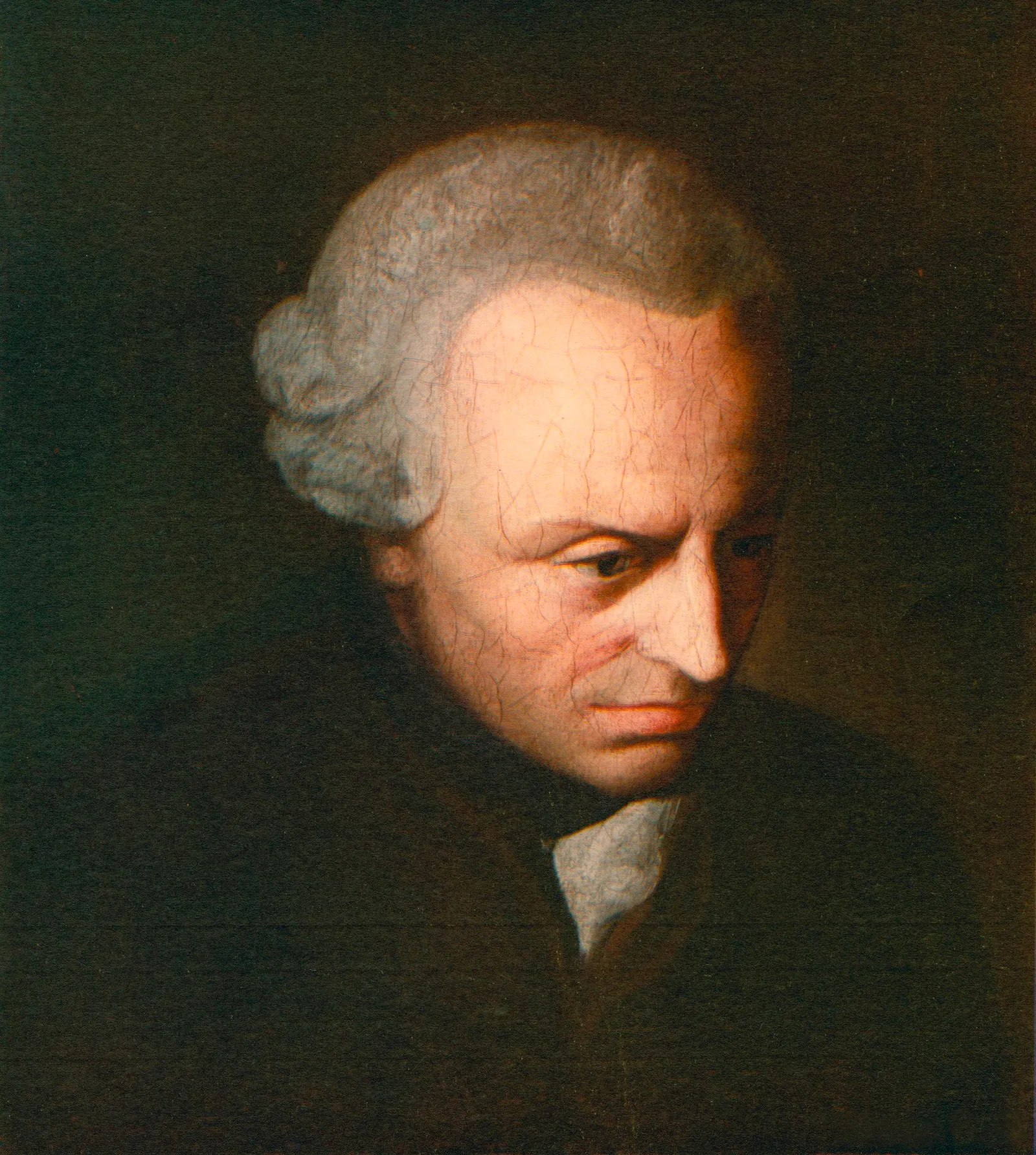
In 1797 the Franco-Swiss writer Benjamin Constant published “Des réactions politiques”. In it he took aim at a “German philosopher” who had allegedly claimed that even lying to a murderer asking for the whereabouts of a pursued friend would be a crime. Constant's counter-thesis: the duty to tell the truth cannot be unconditional, since no one has a right to a truth that harms others.
Kant accepted that the charge was aimed at him and replied the same year in the “Berlinische Blätter”. Rather than softening his position, he sharpened it: there is no right to lie — not from benevolence, not even to protect an innocent person. He knowingly set himself against everyday moral intuition, and that is exactly where the lasting provocation of the text lies.
Sources: Wikipedia: On a Supposed Right to Tell Lies from Benevolent Motives · Wikipedia (German): Über ein vermeintes Recht aus Menschenliebe zu lügen
The argument
Kant's reply is not an appeal to good conscience but a legal-philosophical argument in four steps.
- 1Truthfulness, not truth
Kant's concern is not objective truth — one may be mistaken. It is truthfulness: the honesty of one's own declaration. Whoever makes a statement must mean what they say.
- 2A duty of right, not merely of virtue
For Kant, truthfulness is a perfect duty of right — it holds without exception. It is not an imperfect duty of virtue that would leave room for weighing circumstances.
- 3A lie always harms — humanity itself
Even a lie that harms no particular person harms humanity in general: it corrupts the trust in declarations on which all binding agreements — and with them the legal order itself — depend.
- 4Unforeseeable consequences, no exceptions
The consequences of a lie can never be foreseen with certainty — the liar becomes answerable for them. And admitting exceptions to a principle of right would destroy the very universality that makes it a principle at all.
A lie always harms another; if not another human being, then humanity in general, since it renders the source of right unusable.
Kant, On a Supposed Right to Lie from Philanthropy (1797), Ak. 8:426 — own translation
Sources: Wikipedia: On a Supposed Right to Tell Lies from Benevolent Motives · Wikipedia (German): Über ein vermeintes Recht aus Menschenliebe zu lügen
The key sentence on truthfulness
On a Supposed Right to Lie from Philanthropy · Ak. 8:426
Kant's German original
Wahrhaftigkeit in Aussagen, die man nicht umgehen kann, ist formale Pflicht des Menschen gegen jeden, es mag ihm oder einem andern daraus auch noch so großer Nachteil erwachsen; […]
The exercise uses our own close translation, which keeps Kant's sentence structure.
Which parts can you leave out without the sentence falling apart? Tap them and they step back. Then check your choice.
Truthfulness in statements that one cannot avoid is a formal duty of a human being towards everyone, however great the disadvantage that may arise from it for him or for another; […]
Plain words: our paraphrase, not a Kant quotation
If you cannot avoid making a statement, you must be honest, towards every human being, even if great harm comes of it to you or to others.
The slider unlocks once you have checked your choice.
The frame: Truthfulness in statements that one cannot avoid is a formal duty of a human being towards everyone.
Stepping back does not mean unimportant. The clause “that one cannot avoid” belongs to the frame: it limits the duty to statements one cannot evade. The addition at the end still carries great weight, because it makes the duty hard: it holds even when great harm threatens.
Key words
Once you have checked your choice, the underlined words can be opened.
Tap an underlined word in the sentence.
truthfulness (Wahrhaftigkeit)
- In Kant
- Saying what you yourself hold to be true. A “right to the truth” is “a word without sense”, Kant writes on the same page; one has a right to one's own truthfulness (Ak. 8:426, our translation).
- In everyday speech
- Truth and truthfulness are often used interchangeably: whoever tells the truth is right.
- Easy to confuse
- Someone who is mistaken is still truthful as long as they say what they believe. Lying, by contrast, means deliberately declaring something untrue.
cannot avoid (nicht umgehen)
- In Kant
- Cases in which you cannot stay silent or evade. Kant asks about cases “where he cannot evade answering yes or no” (Ak. 8:426, our translation).
- In everyday speech
- In German, “umgehen” can also mean getting round a rule.
- Easy to confuse
- The duty concerns only statements you cannot get round. Where you can stay silent or evade, the question does not arise in this form.
formal duty (formale Pflicht)
- In Kant
- A duty that does not depend on how the individual case turns out. Kant gives the reason in the same sentence: with a lie I bring it about, “as far as in me lies, that statements (declarations) find no credence at all” (Ak. 8:426, our translation).
- In everyday speech
- Formal sounds like forms and formality: a mere formality.
- Easy to confuse
- Not a mere formality. In a footnote Kant makes clear: “here, however, we are speaking of a duty of right” (Ak. 8:426 note, our translation); lying as a violation of duty to oneself belongs, he says, to ethics. How strictly Kant means it, above all in the case of the murderer at the door, is still disputed today.
Impact & relevance today
Few Kant texts are attacked as passionately — or defended as stubbornly.
Criticism started early and has never stopped. Schopenhauer mocked the derivations of the ban on lying from the human faculty of speech that textbooks gave in Kant's wake as “platt, kindisch und abgeschmackt” (flat, childish and tasteless); and here, too, applies the criticism of rigorism and of the “empty formula” of the categorical imperative that Hegel and later Adorno and Horkheimer levelled at Kant's moral philosophy as a whole. After the Second World War the case acquired a darker edge: to many readers, Helga Varden notes, Kant's position seems simply absurd once the murderer at the door is imagined as a Nazi hunting for Jews in hiding. Among contemporary critics, Christine Korsgaard turns Kant's own tools against him: the humanity formula of the categorical imperative, she argues, can permit the lie, so that truth does not become an instrument of evil.
Yet the essay has its defenders. Varden herself argues that Kant's view has been widely misrepresented — for Kant, the wrong of lying never depended on harm done to the listener in the first place, so the standard objection misses its target. German scholars such as Georg Geismann and Hariolf Oberer hold that the argument is consistent within Kant's premises, and Gerhard Schönrich stresses that Kant is no pure ethicist of inner conviction: the erosion of trust that lying causes is itself a consequence he takes seriously. The scholarly debate remains genuinely open — Jens Timmermann's study “Kant and the Supposed Right to Lie” (2025) is, according to its publisher, the first monograph to explore the essay in detail.
Whether one finally sides with Kant or with Constant, the little essay keeps doing what great philosophy does: it forces us to say exactly why we think we may lie — and to face what a world in which everyone claimed that right would look like.
Sources: Wikipedia: On a Supposed Right to Tell Lies from Benevolent Motives · Wikipedia (German): Über ein vermeintes Recht aus Menschenliebe zu lügen (reception)