Immanuel KantLife · Work · Legacy
ILife

A life in Königsberg

Immanuel Kant revolutionised European thought without ever travelling far: his whole life unfolded in a single city — Königsberg in Prussia.

Origins and childhood

A craftsman's household, a devout mother and a strict school shaped the early years.

Kant was born in Königsberg on 22 April 1724 and baptised “Emanuel” (his birthday was St Emanuel's name day in the Prussian calendar); he later adopted the spelling “Immanuel”. His father, Johann Georg Kant, was a harness maker from Memel (today Klaipėda in Lithuania); his mother, Anna Regina Reuter, was born in Königsberg. Immanuel was the fourth of nine children, only some of whom reached adulthood.

The household was deeply shaped by Pietism, a Protestant reform movement that prized religious devotion, humility and a literal reading of the Bible. In 1732 the boy entered the Collegium Fridericianum, the city's Pietist model school directed by Franz Albert Schultz, from which he graduated in the summer of 1740.

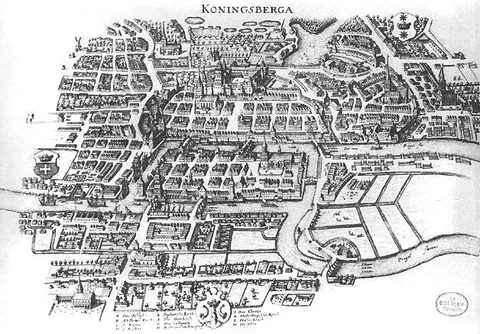
Historic bird's-eye engraving of the city of Königsberg
Königsberg around 1652 (engraving after Merian): the trading and university city on the Pregel river was Kant's entire world — from his birth in 1724 to his death in 1804.Image: Merian-Erben · Public domain · Wikimedia Commons
NoteKönigsberg, 1763
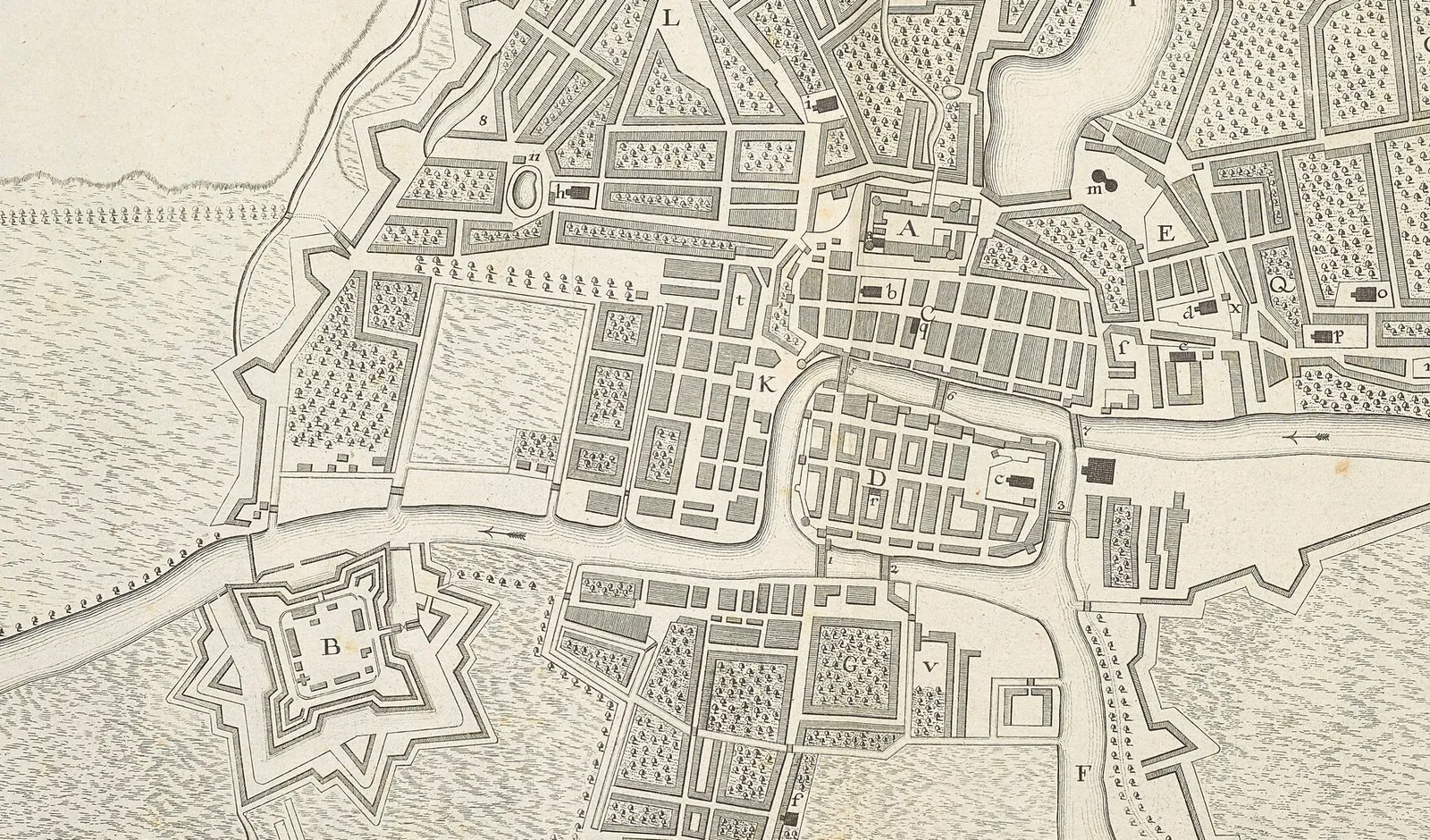
Plan of the city of Königsberg, 1763 (city centre detail)
Image: o. A. · CC0 · Wikimedia Commons

Reference: Plan of the city of Königsberg, 1763 · Source

Kant spent nearly his whole life in Königsberg. When this plan was made he was nearly forty and not yet a professor.

New in your logbook · See the collection

Source: Wikipedia: Immanuel Kant (family, childhood and education)

The long road to the professorship

Thirty years lie between enrolment and the chair — tutoring jobs, modest posts and a great deal of patience.

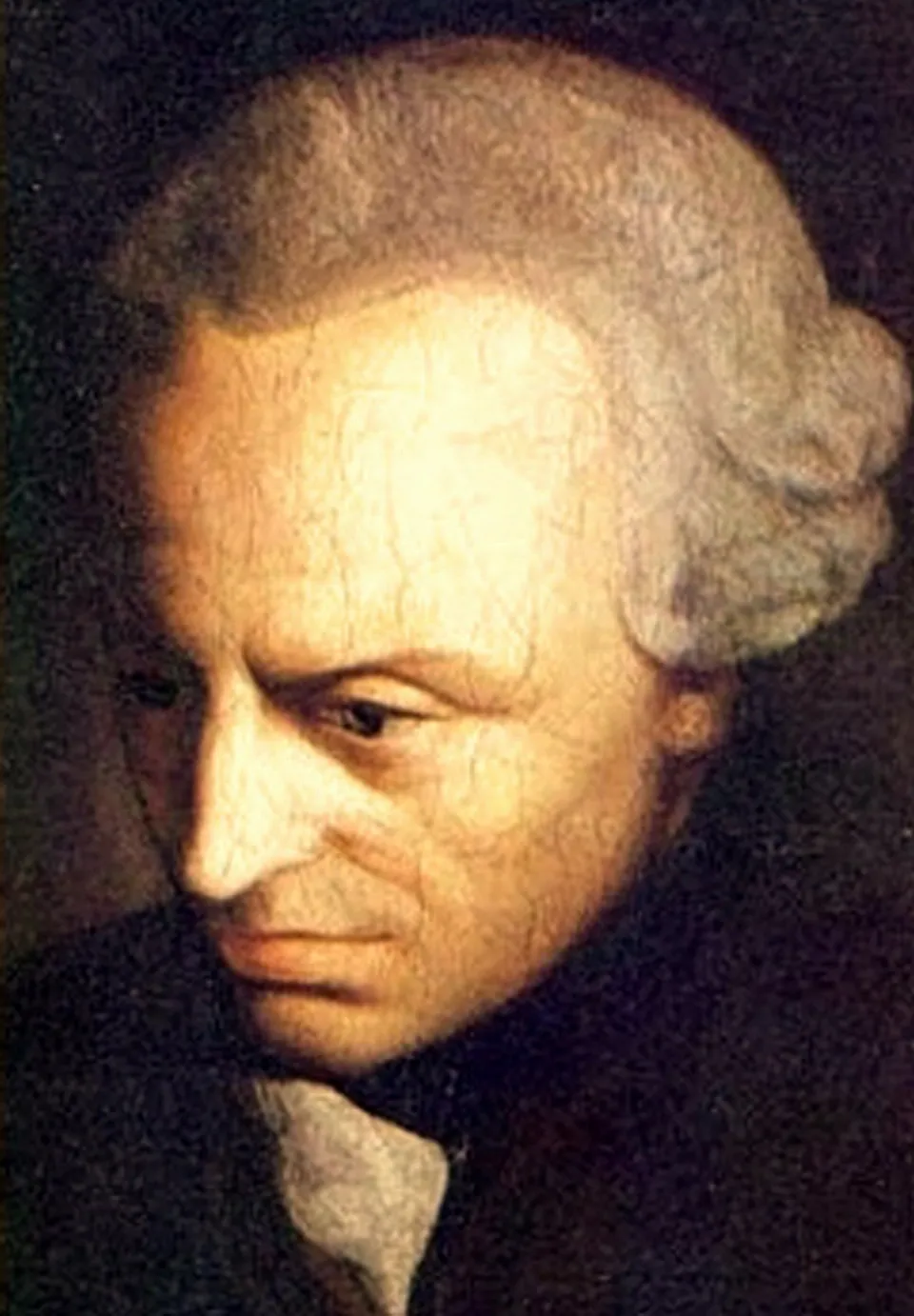
Portrait painting of Immanuel Kant
Immanuel Kant in portrait. Only at 46 did he obtain the professorship of logic and metaphysics he had long hoped for.Image: unbekannt, möglicherweise Elisabeth von Stägemann (Schule von Anton Graff) · Public domain · Wikimedia Commons

In 1740, aged sixteen, Kant enrolled at the University of Königsberg, where he would spend his entire professional life. Under Martin Knutzen he studied the rationalist philosophy of Leibniz and Wolff — but Knutzen, unusually, also introduced him to British philosophy and to Newtonian physics, a combination that shaped Kant's thinking for good.

Then life interrupted the career: his father suffered a stroke and died in 1746. Kant left Königsberg after August 1748 and spent years as a private tutor in the towns around the city, continuing his own research on the side — his first book, on the “true estimation of living forces”, had already appeared in 1749. In August 1754 he returned for good.

  1. 1
    1740 — student at the Albertina

    Kant enrols at sixteen; Martin Knutzen opens the door to Newton and British philosophy.

  2. 2
    c. 1748–1754 — years as a private tutor

    After his father's death Kant teaches in households around Königsberg while pursuing his own studies.

  3. 3
    1755 — licence to lecture

    Kant becomes an unsalaried lecturer and teaches mathematics, physics, logic and metaphysics; from 1757 he is one of the first anywhere to teach geography as a subject in its own right.

  4. 4
    1758 — a failed application

    After an earlier bid in 1756 had also failed, his application for the vacant chair of logic and metaphysics fails; the position goes to another candidate.

  5. 5
    1770 — professor of logic and metaphysics

    At 46, Kant finally receives the full professorship; his inaugural dissertation treats the form and principles of the sensible and the intelligible world.

The waiting years were anything but idle. Kant tackled prize questions of the Berlin Academy, proposed the nebular hypothesis of the origin of the solar system in his “Universal Natural History and Theory of the Heavens” (1755), wrote on the Lisbon earthquake and the theory of winds, and became a genuinely popular author — his “Observations on the Feeling of the Beautiful and Sublime” (1764) made his name well beyond the university, and in the Berlin Academy's prize competition of 1763 (his essay was printed in 1764) he came second only to Moses Mendelssohn.

Source: Wikipedia: Immanuel Kant (young scholar, early works, professorship)

The famous daily routine

No thinker is as identified with his timetable as Kant — though the legend is only half the truth.

In his later years Kant lived a strictly ordered life — so regular, the story goes, that Königsberg's citizens set their watches by his walks (see the punctuality legend below). He never married, although he apparently considered it twice — once with a widow, once with a girl from Westphalia — and on both occasions waited too long to decide. A hermit he was not: he kept a rewarding social life, was a popular teacher and a modestly successful author, and liked to gather friends around his dinner table.

NoteGraces and Muses

… not fewer than the number of the Graces and not more than that of the Muses …

Reference: Anthropology from a Pragmatic Point of View (1798), § 88, Ak. 7:278 · Read the original

That is how large a good dinner party should be: at least three, like the three Graces, at most nine, like the nine Muses. In a footnote Kant does not count the host who serves the guests. He explicitly takes the rule from Lord Chesterfield.

Translation: Our own translation of the German original.

New in your logbook · See the collection

Sources: German Wikipedia: Kantiana (daily routine, dinner table, walk) · Wikipedia: Immanuel Kant

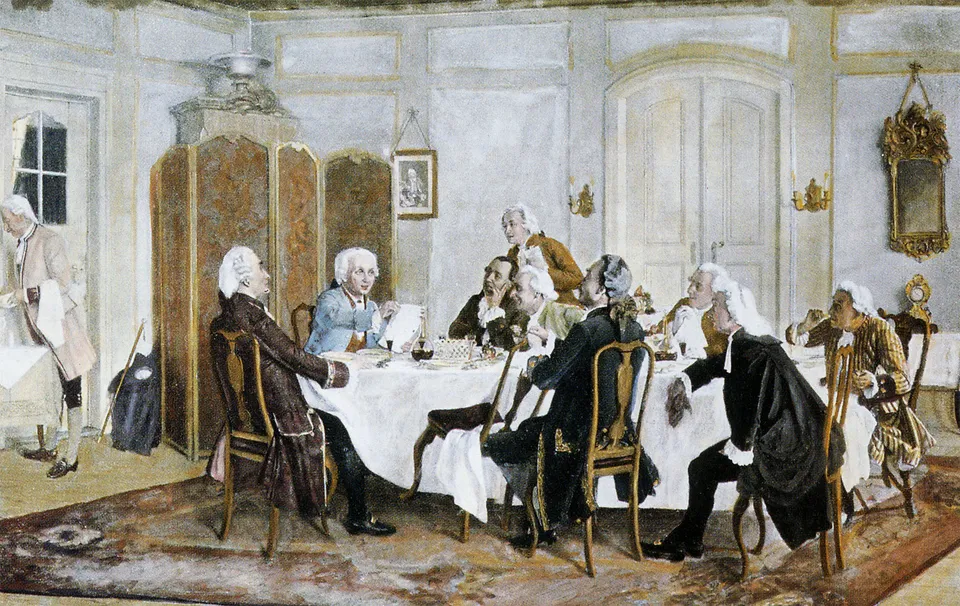
Painting of Immanuel Kant in conversation with his dinner companions at a laid table
Kant and his dinner companions (painting by Emil Doerstling): the midday table with friends was a fixed part of Kant's day — philosophy, however, was off the menu.Image: Emil Doerstling · Public domain · Wikimedia Commons

Sources: Wikipedia: Immanuel Kant (daily routine, social life) · German Wikipedia: Immanuel Kant (the punctuality legend, Joseph Green)

A day in Königsberg

Kant barely ever left his home town. Here his day runs hour by hour across the city plan of 1763.

Turn the clock: drag the slider or the hand, or tap a time of day. The 1763 city plan lights up where Kant is at that moment.

036912151821
4:45

Where:

The table is not laid yet. At one o'clock Lampe announces: “The soup is on the table.”

Join the dinner table
1763 plan of Königsberg with the castle, the Kneiphof island, the cathedral and Fort Friedrichsburg
“Plan Der Stadt Koenigsberg”, 1763 — detail. The letters are the engraver's: A castle, B Fort Friedrichsburg, c cathedral, D Kneiphof; the numerals 1–7 mark the Pregel bridges.Image: o. A. · CC0 · Wikimedia Commons

Kant's walk (simplified)

What the picture leaves out

The clock shows a model day of the older Kant, pieced together from accounts written after his death. The young Kant who played billiards and liked going out into society does not appear in it. The time of the walk is disputed, the position of the house on the plan is approximate, and the line of the route only connects the stations the sources mention; it does not follow the streets.

Embed this clock on your own website

Copy the HTML code to embed Kant's interactive 24-hour clock via <iframe> in your article, blog or course page:

Embed this map on your own website

Copy the HTML code to embed the interactive Königsberg map via <iframe> in your article, blog or course page:

Sources: Wikipedia (German): Kantiana (house, daily routine, dinner table, walk) · Wikipedia: Immanuel Kant · Wikipedia: Seven Bridges of Königsberg

Kant's dinner table

At midday Kant's house was full of guests, and he had rules for the conversation at table.

The midday meal was the only full meal of Kant's day, and he took it seriously. Shortly before one the guests gathered in the visitors' room or the study; at one o'clock, by the castle bell, Martin Lampe announced: “The soup is on the table.” Kant chose his table companions from different age groups, all younger than himself, and with some he had favourite topics: with Johann Gottfried Hasse the origins of words, with Johann Friedrich Schultz politics, with the physician William Motherby health. The mayor, Theodor Gottlieb von Hippel, had a place of honour.

How a good conversation at table should go is something Kant wrote down in his Anthropology from a Pragmatic Point of View (1798). He takes the number of guests from Lord Chesterfield: no fewer than the three Graces, no more than the nine Muses; for a conversation among people of taste the party itself should be “not much above the number of the Graces” (own translation). The conversation at a full table, he says, usually passes through three stages: narrating, reasoning and jesting. He adds rules: a subject that concerns everyone; no deadly silence; no jumping from one subject to the next without need; no obstinacy; and in serious dispute so much respect for one another that nobody goes home angry.

To dine alone (solipsismus convictorii) is unhealthy for a philosophising scholar.

Kant, Anthropology from a Pragmatic Point of View (1798), § 88, Ak. 7:279 f., own translation

Imagined dinner party following Kant's rules

Just before one. The guests are waiting in the visitors' room; Kant glances at the clock: he dislikes unpunctuality.

1. Whom do you invite?

Tap guests to seat them at the table or to uninvite them. For the number of guests, Kant adopts a rule from Lord Chesterfield.

K

0 guests

Dining alone?

“To dine alone (solipsismus convictorii) is unhealthy for a philosophising scholar.”

Anthropology § 88, Ak. 7:279 f., own translation

2. Steer the conversation

At each course, choose how things go on. In his Anthropology Kant describes how a good conversation at table unfolds. Guests first: there must be between three and nine.

  1. 1The soup Narrating

    How does the conversation begin?

  2. 2The main course Reasoning

    Two guests see a matter differently, the tone grows sharp, and one of them insists on being right. What do you do?

  3. 3The dessert Jesting

    How should the meal end?

On to the table talks
What the picture leaves out

The party is imagined: who sat at Kant's table on which day is not recorded; the names come from his circle. Kant describes the three stages in the Anthropology (1798) for a “full table” in general, not explicitly for his own. There he also reckons with tables at which ladies are present; the jesting at the end is partly meant “to please the women present” (Ak. 7:278 note, 280 f., own translation). According to the biographer Steffen Dietzsch, no women ever sat at Kant's own table.

Sources: Kant, Anthropology § 88, Ak. 7:278–281 (korpora.org, German) · Wikipedia (German): Kantiana (dinner table) · Wikipedia: Theodor Gottlieb von Hippel · Wikipedia: Joseph Green · Wikipedia (German): Johann Gottfried Hasse (table companion)

Table talks

Kant's friends and correspondents contradicted him, and sometimes he answered.

Kant's ideas did not arise in a vacuum. Five objections are gathered here: Hippel's demand for equal rights for women, Garve's charge that Kant was an idealist like Berkeley, Schiller's criticism of strict duty, Maria von Herbert's despairing question whether concealment is already a lie, and Hamann's objection that there is no reason without language. The round in which they sit together here is imagined; every objection and every answer is documented.

Each objection raises two questions. What Kant answered can be checked against his writings; there is a right answer to that, with a source. Who convinces you is for you to decide; there is no right answer to that.

Imagined round of conversation: only what is documented is said

Choose a person. The conversations are imagined: Garve, Schiller and Maria von Herbert never sat at Kant's table; their objections came as books or letters. First you check whether you know Kant's answer, then you decide who convinces you. There is no right or wrong in that.

Theodor Gottlieb von Hippel 1741–1796

Mayor, guest of honour at Kant's table

In 1792 his book On the Civil Improvement of Women appears anonymously.

Women should have the same civil rights as men.

paraphrased

What does Kant answer? What does Kant write about the right to vote in his Doctrine of Right five years later (1797)?

Source

“The journeyman of a merchant or a craftsman; the servant …; the minor …; all women and in general anyone who is compelled to maintain his existence (food and protection) not by his own business but by the disposal of others (other than the state), lacks civil personality” (own translation).

Metaphysics of Morals, Doctrine of Right § 46, Ak. 6:314

Hippel did not live to see it: he died in 1796.

More on this

Wikipedia: Theodor Gottlieb von Hippel the Elder · Kant, MM § 46, Ak. 6:314 (korpora.org, German)
Christian Garve 1742–1798

Philosopher in Breslau, correspondent

In 1782 his review of the Critique of Pure Reason appears in the Göttingische gelehrte Anzeigen, shortened by Johann Feder.

“This work is a system of transcendental (or … higher) idealism.” The point: Kant teaches, like Berkeley, that the world is mere representation.

as Kant quotes the review, Ak. 4:373, own translation

What does Kant answer? What does Kant answer in the Prolegomena of 1783?

Source

“All cognition of things from mere pure understanding or pure reason is nothing but sheer illusion, and only in experience is there truth.” And: “My place is the fertile bathos of experience” (own translation).

Prolegomena, Appendix, Ak. 4:374 and 373 note

To doubt the existence of things had “never entered my mind”, he writes (Ak. 4:293, own translation).

Wikipedia: Christian Garve · Kant, Prolegomena, Ak. 4:373 f. (korpora.org, German) · Ak. 4:293

Friedrich Schiller 1759–1805

Poet, reader and critic of Kant

In 1793 his essay On Grace and Dignity appears.

Kant makes the relation between sensibility and the law “servile”; duty and inclination should be in harmony in a “beautiful soul”.

after Wikipedia (German): Über Anmut und Würde

What does Kant answer? How does Kant reply in 1794 in a note to his book on religion?

Source

“I readily admit that, precisely for the sake of its dignity, I cannot associate grace with the concept of duty.” But: “the cheerful heart in following one's duty … is a sign of the genuineness of a virtuous disposition”. He praises the essay as “written by a master hand” (own translation).

Religion within the Bounds of Bare Reason, 2nd ed. 1794, Ak. 6:23 f. note

Kant sees no dispute with Schiller “in the most important principles” (own translation).

Wikipedia: On Grace and Dignity · Kant, Religion, Ak. 6:23 f. note (korpora.org, German)

Maria von Herbert 1769–1803

Correspondent from Klagenfurt

In 1791 she writes to Kant in deep despair: she had long concealed an earlier relationship from her friend and herself calls this a lie. Since she confessed it, his love has died.

Kant's moral philosophy does not help her: “I have read the metaphysics of morals along with the categorical imperative, it helps me nothing”.

Ak. 11:273, own translation

What does Kant answer? Is it already a lie not to tell everything? What does Kant answer in his draft letter (1792)?

Source

“What the sincere but reserved (not open-hearted) person says is all true, only he does not say the whole truth. The insincere person, by contrast, says something he is aware is false. A statement of the latter kind is called a lie in the doctrine of virtue” (own translation).

To Maria von Herbert, draft, spring 1792, Ak. 11:332

Even a “wholly harmless” lie is “not therefore innocent” (ibid., own translation).

Wikipedia: Maria von Herbert · Letter from Maria von Herbert, Ak. 11:273 f. (korpora.org, German) · Kant's draft, Ak. 11:331 f.

Johann Georg Hamann 1730–1788

Friend and critic in Königsberg

In 1784 he writes a “Metacritique on the Purism of Reason”.

There is no reason prior to language and history; Kant separates sensibility and understanding too strictly.

paraphrased

What does Kant answer? What does the introduction to the Critique of Pure Reason already say about this?

Source

“that there are two stems of human cognition, which perhaps arise from a common but to us unknown root, namely sensibility and understanding, through the first of which objects are given to us, but through the second of which they are thought” (own translation).

Critique of Pure Reason, A 15/B 29, Ak. 3:46

Kant separates the two stems so that their contribution can be examined; knowledge needs both together (CPR A 51/B 75).

Wikipedia: Johann Georg Hamann · Kant, CPR A 15/B 29, Ak. 3:46 (korpora.org, German)

Two more voices object elsewhere: Friedrich Schiller with a mocking verse at the shopkeeper's, and Benjamin Constant at the murderer at the door.

Sources: Wikipedia: Theodor Gottlieb von Hippel the Elder · Wikipedia: Christian Garve · Wikipedia: On Grace and Dignity · Wikipedia: Maria von Herbert · Wikipedia: Johann Georg Hamann

The critical years

A decade of silence is followed by the most productive stretch in the history of philosophy.

After the inaugural dissertation of 1770 the new professor fell strangely silent. For roughly a decade Kant published next to nothing, isolated himself and resisted his friends' attempts to draw him out — he was working out an entirely new theory of knowledge. In 1781 the result appeared: the “Critique of Pure Reason”.

Then the dam broke. The “Prolegomena” followed in 1783, the famous essay answering the question “What is Enlightenment?” in 1784, the “Groundwork of the Metaphysics of Morals” in 1785, the “Critique of Practical Reason” in 1788 and the “Critique of the Power of Judgment” in 1790 — a run of books that made Kant the dominant philosopher of his age.

He never travelled to enjoy his fame. Kant spent virtually his whole life in and around Königsberg; the world came to him instead, through the books, news and visitors that a busy Baltic trading port supplied in abundance.

Source: Wikipedia: Immanuel Kant (silent decade, critical philosophy)

The clash with the censors

Under Frederick William II, of all people the philosopher of Enlightenment fell foul of the authorities.

In 1792, with Prussia alarmed by the French Revolution, King Frederick William II's censorship commission blocked Kant's attempt to publish part of his book on religion in the Berlinische Monatsschrift. Kant found a workaround: he had the complete work, “Religion within the Boundaries of Mere Reason”, cleared through the philosophy faculty of the University of Jena instead — and earned himself a now-famous royal reprimand.

When a second edition appeared in 1794, a royal rescript of 1 October 1794 rebuked Kant for misusing his philosophy to distort and disparage central teachings of Scripture and Christianity, and demanded that he commit no such offence again. Kant himself answered with a promise to abstain from all public statements on religion — for as long as the king lived. He kept it for the rest of the reign — and settled the score in 1798, after the king's death, with “The Conflict of the Faculties”, in which he published and answered the reprimand.

Sources: Wikipedia: Immanuel Kant (censorship under Frederick William II) · Kant, The Conflict of the Faculties (1798), Preface: rescript and reply, Ak. 7:6 and 7:10 (German original; our paraphrase)

Final years and afterlife

“Es ist gut” — Kant's end in the city that is now Kaliningrad.

Kant's health, poor for a long time, worsened in his final years, and he died in Königsberg on 12 February 1804, shortly before his eightieth birthday. His last words were “Es ist gut” — “It is good”. His unfinished final project was published much later as the Opus Postumum.

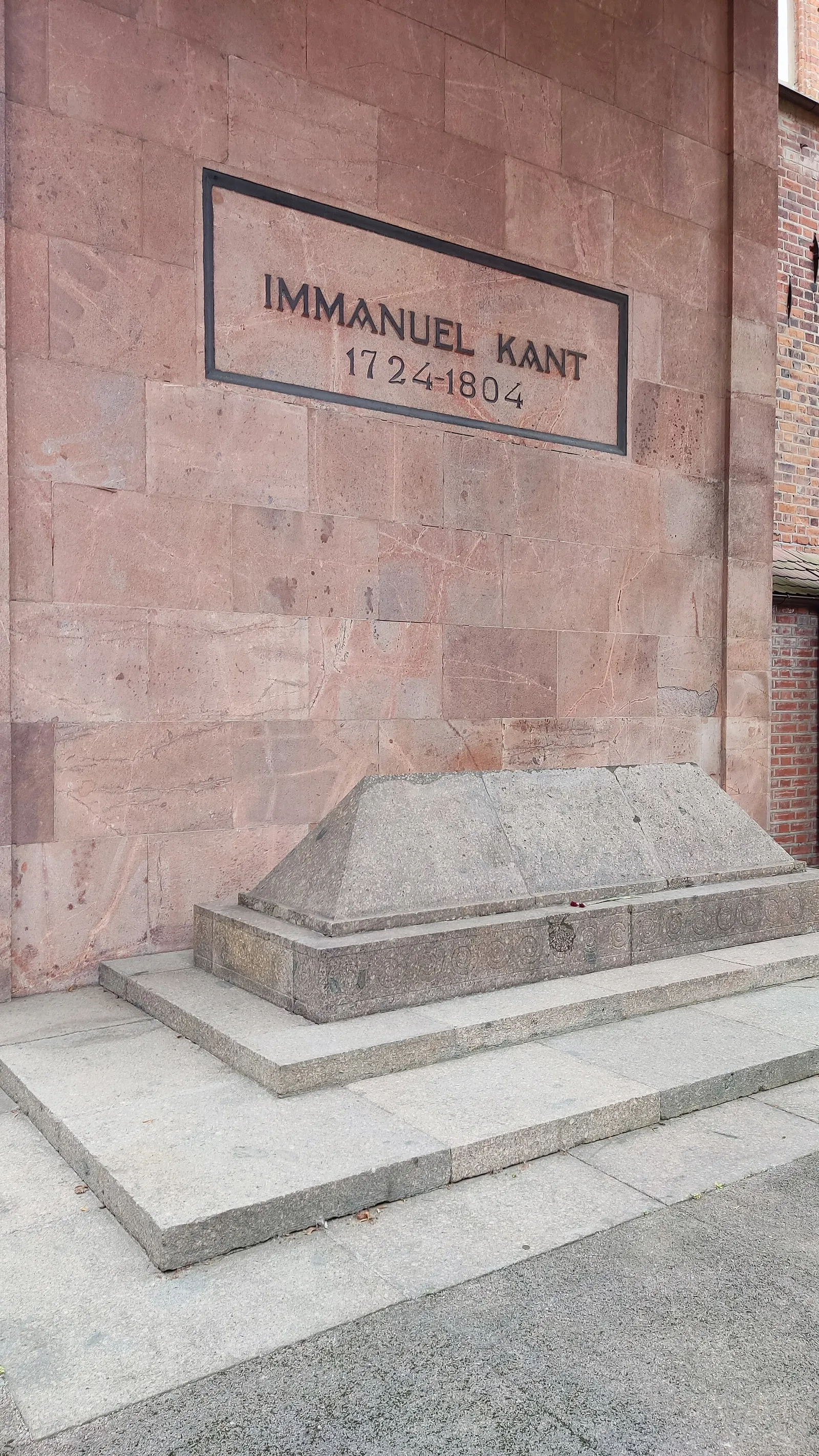
He was buried at Königsberg Cathedral. In 1880 his remains were moved to a neo-Gothic chapel, and when that fell into disrepair, the architect Friedrich Lahrs built the mausoleum that was finished in 1924, in time for the bicentenary of Kant's birth. It still adjoins the northeast corner of the cathedral in today's Kaliningrad — one of the few artifacts of German times the Soviets preserved after taking the city. To this day newlyweds bring flowers to the mausoleum, and since 2010 the local university has borne the name Immanuel Kant Baltic Federal University.

Kant's tomb with its colonnade on the outer wall of Königsberg Cathedral
Kant's tomb at Königsberg Cathedral in present-day Kaliningrad — rebuilt as a mausoleum by Friedrich Lahrs for the bicentenary of 1924.Image: Alexander Grebenkov · CC BY 3.0 · Wikimedia Commons
NoteThree last words

Es ist gut. (“It is good.”)

Reference: Tradition; German Wikipedia calls them “allegedly” his last words, on the day before his death (11 February 1804, according to the article Kantiana; he died on 12 February) · Source

Kant died aged almost eighty in Königsberg, where he had spent nearly his whole life. Whether those three words were spoken exactly like that is not certain.

New in your logbook · See the collection

Source: Wikipedia: Immanuel Kant (death, tomb and legacy)

Kant in facts and figures

The life at a glance — every station in one table.

Born
22 April 1724 in Königsberg (Prussia), fourth of nine children of a harness maker
School
Collegium Fridericianum from 1732; graduated in summer 1740
University
enrolled at the University of Königsberg in 1740, aged sixteen
Private tutor
c. 1748 to 1754, in towns around Königsberg
Lecturer
from 1755 — teaching mathematics, physics, logic, metaphysics and, from 1757, geography
Professorship
1770, aged 46: logic and metaphysics
Major works
1781 Critique of Pure Reason · 1785 Groundwork · 1788 Critique of Practical Reason · 1790 Critique of the Power of Judgment
Died
12 February 1804 in Königsberg — last words: “Es ist gut” (“It is good”)
Tomb
at Königsberg Cathedral; mausoleum by Friedrich Lahrs, completed 1924
NoteThe note about Lampe

The name Lampe must now be completely forgotten.

Reference: Handed down from Kant's notebook (after German Wikipedia, article Martin Lampe); not checked against the Academy edition · Source

Martin Lampe served Kant for about forty years. After dismissing him in 1802, Kant out of habit called his new servant “Lampe” too, and wrote this sentence into a small notebook.

Translation: Our own translation of the German original.

New in your logbook · See the collection

Source: Wikipedia: Immanuel Kant (life dates and works)

To see how these stations interlock with the works and with world events, visit the timeline; the books themselves are presented in the Works chapter.