What should I do?
Kant's second great question concerns morality. His answer starts neither with commandments, feelings nor consequences — but with the will of the person acting.
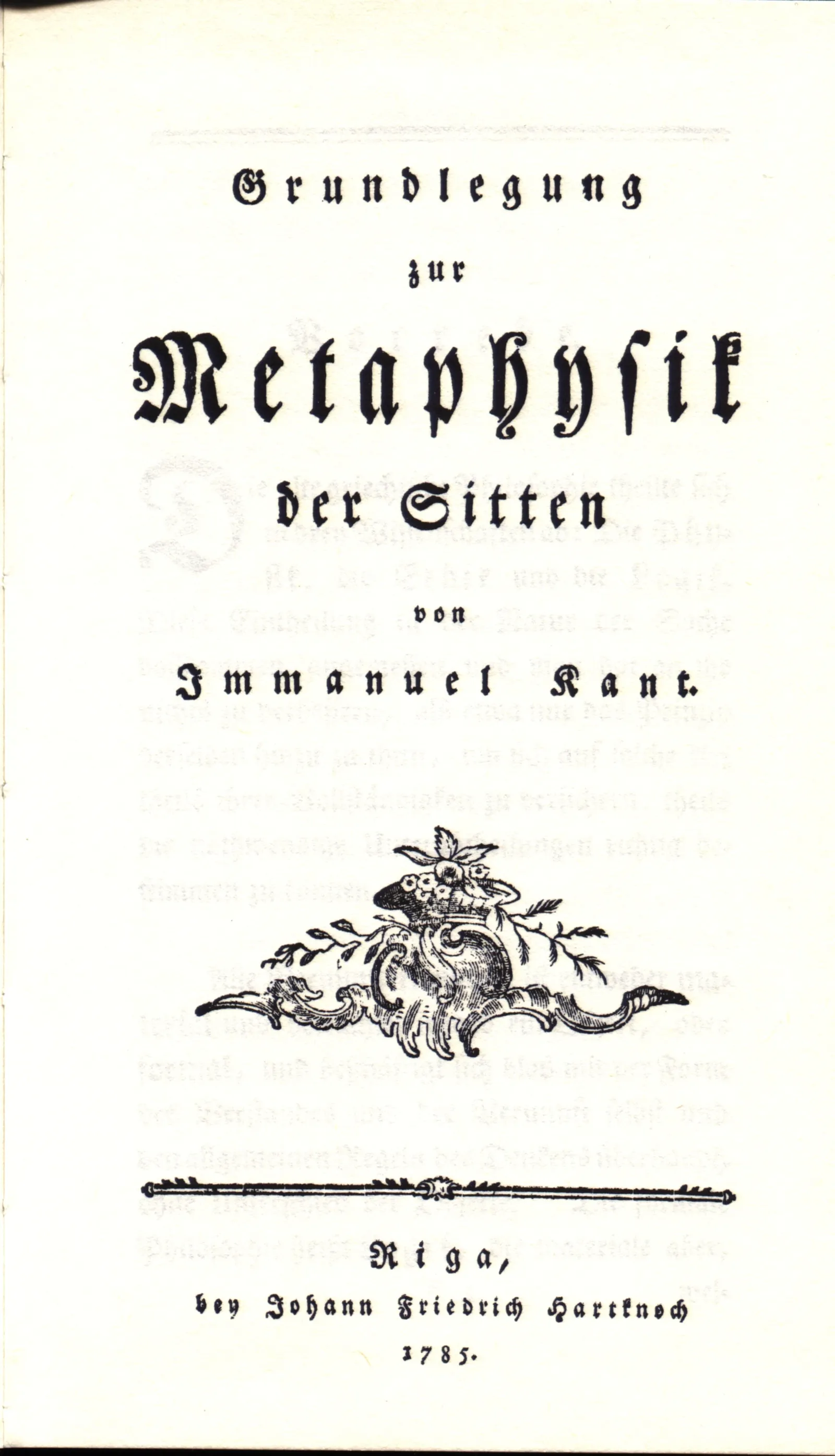
In 1785 Kant published the “Groundwork of the Metaphysics of Morals” — a short book with an enormous ambition: to identify and establish the supreme principle of morality, independent of worldviews, traditions and contingent experience. In three “transitions” it leads from everyday moral experience to philosophical justification. Its famous starting point is the good will: nothing in the world, or even beyond it, can be called good without qualification except a good will alone.
A good will is not good because of what it effects or accomplishes, because of its fitness to attain some proposed end, but only because of its volition, that is, it is good in itself.
Kant, Groundwork of the Metaphysics of Morals (1785), Ak. 4:394 — English translation
Talents such as wit and judgment, strengths of character such as courage, even happiness — all of these are only conditionally good for Kant: in the hands of a bad will they can do harm. The good will alone shines by its willing, not by its success. The course is set: morality is decided within, not by results.
From duty — not merely in conformity with duty
Whether an action has moral worth is decided, for Kant, not by its outcome but by its motive.
Kant's best-known illustration is the honest shopkeeper: a merchant who charges every customer the same fair price acts, outwardly, exactly as he should. But if he does so merely out of prudence — because honest shops win trust and returning customers — his action is only in conformity with duty: it matches what duty demands, while its motive is self-interest, and so it lacks moral worth. The very same action gains moral worth only when the merchant is honest because he refuses to cheat anyone — when he acts from duty, with the commercial benefits as a mere side effect.
One and the same visible action can thus carry a completely different moral weight, depending on the maxim behind it. Importantly, duty for Kant is no alien command from above: the obligation arises from one's own rational insight.
Sources: Wikipedia: Groundwork of the Metaphysics of Morals (duty, shopkeeper example, maxim) · Wikipedia: Categorical imperative
Two good deeds under the X-ray screen
An invented scene based on Kant's examples in the Groundwork (Ak. 4:397 f.). Kant quotations: our own translation from the German.
The shopkeeper gives a child change just as honestly as any adult.
“Anyone known as a cheat loses customers.”
Motive: his own advantage
in conformity with duty
The friend of humanity helps a neighbour because it gives her joy.
“I am glad when others are happy.”
Motive: inclination, that is, sympathy
in conformity with duty
1 · Your verdict
Both do the decent thing. Which deed has more moral worth? Tap your answer.
2 · X-ray view
From the outside both deeds look equally good. The screen shows why they happen.
Both actions are in conformity with duty: they agree with what duty requires. The screen shows the reason for which they are done.
3 · Change the circumstances
Change the situation and see what is left of the good deed.
Imagine that cheating the child would never come to light. Then his advantage no longer supports his honesty: it rested on his profit, “his advantage required it” (Ak. 4:397). This test is not in Kant; it only makes visible what the shopkeeper's honesty rests on.
This twist is Kant's own: her mind is clouded by a grief of her own that “extinguishes all sympathy with the fate of others” (Ak. 4:398). The joy in helping is gone. What does she do?
Now the screen shows a different motive: duty. This is exactly Kant's point: if she did the action “without any inclination, solely from duty, then for the first time it has its genuine moral worth” (Ak. 4:398).
Then it was inclination that carried her help. Kant does not reproach her for it: her earlier help was “amiable” and deserves praise. But he sees its “true moral worth” only where someone helps without inclination, because it is a duty (Ak. 4:398).
4 · Three voices
Try both circumstances. Then look at Kant's answer.
Your choice:
Both deeds are in conformity with duty; neither is yet done from duty. The shopkeeper acts “merely with a self-interested aim” (Ak. 4:397). Help given out of joy, “however dutiful, however amiable it may be”, has “no true moral worth”: it deserves “praise and encouragement, but not esteem” (Ak. 4:398). For Kant a deed has moral worth when it is done from duty.
Later, in two couplets of the Xenien (1796, published with Goethe), Schiller mocked this (our translation): “Gladly I serve my friends, but alas I do it with inclination, / And so it often gnaws at me that I am not virtuous.” And the reply: “There is no other counsel; you must try to despise them, / And then do with aversion what duty commands.” As early as 1794 Kant had replied to Schiller's treatise “On Grace and Dignity” (1793) in a note in his book on religion: they were “agreed on the most important principles” (Ak. 6:23 note).
Sources: Kant, Groundwork, Ak. 4:397 (German original, korpora.org) · Ak. 4:398 · Ak. 4:407 · Religion, Ak. 6:23 f. note · Schiller, “Gewissensskrupel” (German, Zeno.org) · Schiller, “Decisum” (German, Zeno.org) · Wikipedia: Groundwork of the Metaphysics of Morals · Wikipedia: On Grace and Dignity
The categorical imperative
How do I test whether my maxim is morally sound? Kant's answer is not a catalogue of commandments but a procedure.
Statements of “ought” are what Kant calls imperatives — and he distinguishes two fundamentally different kinds:
- Hypothetical imperative
- Binds only on condition of an end: “If you want to stay healthy, don't eat too much chocolate.” Such rules of skill and counsels of prudence oblige no one morally — give up the end and the rule lets go of you.
- Categorical imperative
- Commands unconditionally, independent of ends and inclinations. It obliges not through the content of an action but through its form — the universalisability of the maxim — and holds for every rational being.
- The test
- State your maxim → turn it, in thought, into a universal law → check for contradiction. If the maxim fails already in conception (if everyone made false promises, no promise would be believed — the very concept destroys itself), it violates a perfect duty; if it merely cannot be willed consistently, an imperfect one.
- Not the golden rule
- “Do as you would be done by” measures actions against one's own wishes. Kant dismissed it as trivial: it is merely derived from the categorical imperative and cannot be a universal law, since it grounds neither duties to oneself nor duties of love towards others (Ak. 4:430, footnote). The categorical imperative instead tests maxims against reason.
Sources: Wikipedia: Categorical imperative · Wikipedia: Groundwork of the Metaphysics of Morals
Kant insists there is only one categorical imperative. The famous formulas of the Groundwork light up the same principle from different sides:
- 1Universal law formula
“Act only according to that maxim whereby you can at the same time will that it should become a universal law.” (Ak. 4:421) The basic formula: whatever is to count for me must be thinkable — and willable — as a law for everyone.
- 2Law of nature formula
“Act as if the maxims of your action were to become through your will a universal law of nature.” (Ak. 4:421) A thought experiment: imagine a world in which your rule holds as exceptionlessly as gravity — does it still work?
- 3Humanity formula (end in itself)
“Act in such a way that you treat humanity, whether in your own person or in the person of any other, never merely as a means to an end, but always at the same time as an end.” (Ak. 4:429) People must never be merely used — the core of what we now call human dignity.
- 4Autonomy and the kingdom of ends
The will of every rational being is a universally legislating will: it obeys no alien law but its own — autonomy instead of heteronomy. And all self-legislators together form an ideal “kingdom of ends”, of which each agent should act as a lawgiving member.
Sources: Wikipedia: Categorical imperative (formulations); Kant quotations in English translation of the German original · Wikipedia: Groundwork of the Metaphysics of Morals
Try it: the triple maxim test bench
Got the theory? Send a maxim through three tests, one for each formula: law of nature, end in itself and kingdom of ends. Kant's own examples are included, plus a counter-test.
Does your rule hold as a law for everyone?
Pick a maxim. First commit to what you expect, then send it through three stations. Kant quotations: our own translation from the German; the short formulas stay close to Gregor's standard rendering (Cambridge edition).
When I am short of money, I borrow and promise to repay, although I know I never will.
Your guess
What do you expect if everyone acts on this rule?
Station 1 · Law of nature
“Act as if the maxim of your action were to become through your will a universal law of nature.” (Ak. 4:421)
Drag the slider from “just me” to “everyone” and watch the town.
As a universal law the rule would make “the promise and the end one may have in making it itself impossible, since nobody would believe that anything was promised to him” (Ak. 4:422). It cannot even be conceived without contradiction.
This world can be conceived: “a nature according to such a universal law” could “still always subsist” (Ak. 4:423). But can you will it?
This world can be conceived: the human race, says Kant, “could very well subsist” (Ak. 4:423). But can you will it?
No breaking point: a world in which everyone keeps their promises can be conceived, and you can will it too. Promises there would, if anything, become more reliable.
No: “as a rational being he necessarily wills that all the capacities in him be developed” (Ak. 4:423).
No: there are cases “where he needs the love and sympathy of others”; with this law he would rob himself “of all hope of the assistance he wishes for himself” (Ak. 4:423).
Station 2 · End in itself
“Act so that you use humanity, whether in your own person or in the person of any other, always at the same time as an end, never merely as a means.” (Ak. 4:429)
What does Kant say: is anyone used merely as a means here?
The lender “cannot possibly agree to my way of behaving towards him”: whoever promises like this wants “to make use of another human being merely as a means” (Ak. 4:429 f.).
Letting one's talents waste away is compatible “with the preservation of humanity as an end in itself, but not with the advancement of this end” (Ak. 4:430). Humanity in you is not used, but not promoted either.
Helping nobody is “only a negative and not a positive agreement with humanity as an end in itself”; the ends of others must “also, as far as possible, be my ends” (Ak. 4:430).
Whoever keeps a promise treats the other as someone who can agree to the deal. This applies Kant's formula; Kant does not discuss this case himself.
Station 3 · Kingdom of ends
Imagine a community in which everyone helps make the laws and everyone is subject to them. Kant calls it the “kingdom of ends”: a rational being belongs to it as a member “when it gives universal laws in it but is also itself subject to these laws” (Ak. 4:433).
Law book of the kingdom of ends
When I am short of money, I borrow and promise to repay, although I know I never will.
Cannot be entered: as a legislator who is subject to it yourself, you cannot enact this rule.
All three stations reach the same result, and that is no accident: “the three ways of representing the principle of morality just cited are at bottom only so many formulas of the very same law” (Ak. 4:436).
Violates a perfect duty to others: one “that permits no exception in favour of inclination” (Ak. 4:421 note).
Hegel considered the categorical imperative a merely formal principle that lets almost any content pass: the form of law alone does not say what to do.
For the curious
Why do we act against such rules anyway? Kant: “if we attend to ourselves whenever we transgress a duty, we find that we do not actually will that our maxim should become a universal law”; “we merely take the liberty of making an exception to it for ourselves or (just this once) in favour of our inclination” (Ak. 4:424). The distinction between the two contradictions: some maxims “cannot even be conceived without contradiction as a universal law of nature”; with others “it is still impossible to will” that they become one (Ak. 4:424).
Sources: Kant, Groundwork, Ak. 4:421 (German original, korpora.org) · Ak. 4:422 · Ak. 4:423 · Ak. 4:424 · Ak. 4:398 · Ak. 4:429 · Ak. 4:430 · Ak. 4:433 · Ak. 4:436 · Wikipedia: Kingdom of Ends · Wikipedia: Categorical imperative · Wikipedia (in German): Kategorischer Imperativ (reception: Hegel)
The categorical imperative is often confused with the Golden Rule. Kant himself drew the line in a footnote of the Groundwork, with two cases you can test here.
Two people who get away with the Golden Rule
“Do not do to others what you would not want done to you.” That sounds like the categorical imperative. Kant objects in a footnote and names two cases himself (Ak. 4:430 note; our translation).
In court
A convicted man says to the judge: “You wouldn't want to go to prison either. So you must not sentence me.”
According to Kant's objection, can he appeal to the Golden Rule?
Kant thinks: by the Golden Rule his objection is hard to refute: it measures by one's own wishes, and nobody wishes to be punished. Kant: “the criminal would on this ground argue against the judges who punish him” (Ak. 4:430 note). The imperative, by contrast, does not ask what the judge wishes for himself but whether his maxim would do as a law for everyone.
The indifferent man
Someone says: “I want help from nobody. In return, I help nobody either.”
According to Kant, does he violate the Golden Rule?
Kant thinks: no. What he does not want, he does to no one. Kant: “many a person would gladly agree that others should not benefit him, if only he might be excused from showing them beneficence” (Ak. 4:430 note). He still fails the imperative, at the will test (station 1, “No help in need”).
Kant's conclusion: “Let it not be thought that the trivial quod tibi non vis fieri etc. could serve here as a guideline or principle.” It is “only derived from the former” and grounds neither duties to oneself nor duties of love to others nor “duties owed to one another” (Ak. 4:430 note).
Sources: Kant, Groundwork, Ak. 4:430 note (German original, korpora.org) · Wikipedia: Golden Rule
Source: Wikipedia: Categorical imperative (the test procedure, Golden Rule)
Now your own maxim
You have worked through Kant's examples — what about a rule from your own everyday life? The tester puts Kant's questions to you one by one.
Source: Wikipedia: Categorical imperative (perfect and imperfect duty, formula of humanity)
Dilemma workshop: you first, then Kant
Eight cases, from the shopkeeper to the murderer at the door. You decide first; then you see Kant's verdict and, where one is documented, an opposing voice.
The Socratic mirror in the workshop is named after Socrates, who tested in conversation whether the convictions of the person he was talking to fitted together. The mirror does something similar with your own verdicts: if two of them pull in different directions, it puts them side by side and asks how the cases differ. It does not say which verdict is the right one.
Source: Wikipedia: Socratic method
The cases are told as short scenes based on Kant's writings; “Rolls at the baker's” applies his formula, Kant does not discuss that case.
Sources: Wikipedia: Utilitarianism · Wikipedia: Jeremy Bentham
The Critique of Practical Reason
Three years after the Groundwork, Kant builds his ethics into a system — connecting morality, freedom and hope.
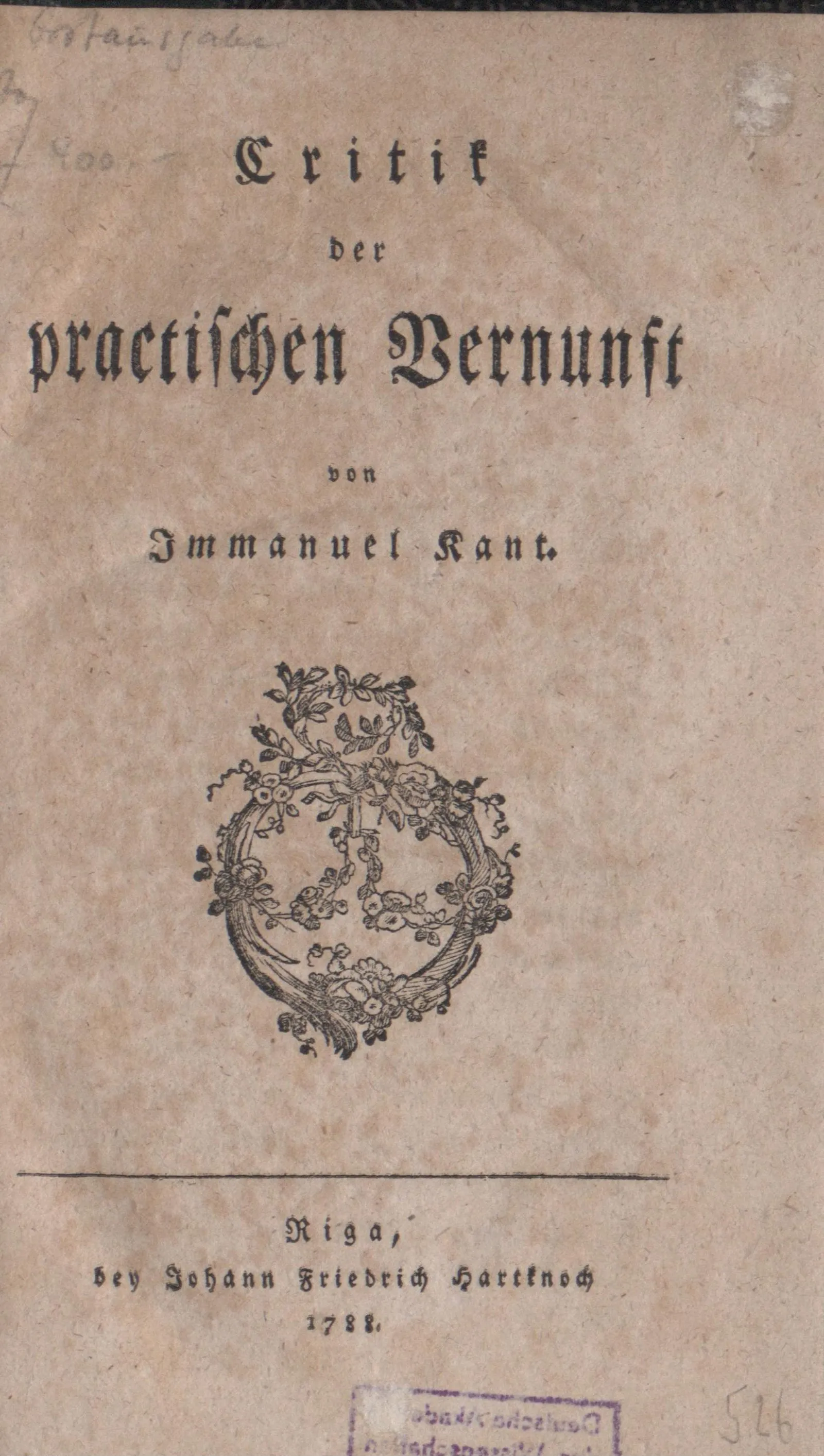
In 1788 the “Critique of Practical Reason” appeared. Its “fundamental law” restates the imperative: “Act in such a way that the maxim of your will could always hold at the same time as a principle of a universal legislation.” (Ak. 5:30, in translation) What is striking is how Kant grounds this law — he doesn't: our consciousness of the moral law is a “fact of reason” that cannot be derived from anything prior; it simply forces itself upon every rational being.
Freedom and the moral law support one another: freedom is the ground of being (ratio essendi) of the moral law — without freedom there could be no “ought”; the moral law, in turn, is the ground of cognition (ratio cognoscendi) of freedom — only through the undeniable “you ought” do I learn that I am free. And because the “highest good” — virtue together with the happiness proportionate to it — cannot be achieved by finite beings on their own, practical reason must postulate three things:
- Freedom
- Presupposed by the moral law itself: only a free will can act from duty — in practical life freedom is thereby real, even though it remains theoretically unprovable.
- Immortality
- Approaching perfect virtue is an endless progress — it demands an existence without end.
- God
- That virtue and happiness finally harmonise is beyond any human power to guarantee — a holy, intelligent cause of nature must be assumed for it.
Postulates are not proofs: Kant does not claim to know that God or immortality exist — practical reason merely has to assume them so that its own goal is no empty promise. The book then closes with one of the finest passages Kant ever wrote:
Two things fill the mind with ever new and increasing admiration and reverence, the oftener and more steadily we reflect on them: the starry heavens above me and the moral law within me.
Kant, Critique of Practical Reason (1788), Conclusion, Ak. 5:161 — English translation

NoteTwo things
Two things fill the mind with ever new and increasing admiration and reverence, the more often and the more steadily reflection is occupied with them: the starry heavens above me and the moral law within me.
Reference: Critique of Practical Reason (1788), conclusion, Ak. 5:161 · Read the original
The most famous sentence of the second Critique comes at the very end. The sky at the top of this site and the constellation in the logo allude to it.
Translation: Our own translation of the German original.
New in your logbook · See the collection
Source: Wikipedia: Critique of Practical Reason (fact of reason, postulates, conclusion)
Hard case: lying from benevolence?
How seriously Kant means the unconditional is shown by a short essay of 1797 — to this day one of the most debated passages in his work.
The French-Swiss thinker Benjamin Constant objected: a principle by which one would have to tell the truth even to a murderer asking whether the friend he is pursuing is hiding in one's house would make any society impossible. Duties correspond to rights — and no one has a right to a truth that harms others. The benevolent lie, Constant concluded, must be permitted.
Kant replied in 1797 with the essay known in English as “On a Supposed Right to Tell Lies from Benevolent Motives” — and did not budge: truthfulness is an unconditional duty of right, a sacred command of reason that no convenience may restrict (Ak. 8:427). A lie always harms — “if not some human being, then it nevertheless does harm to humanity in general, inasmuch as it vitiates the very source of right” (Ak. 8:426, in translation): whoever lies, however good the intention, undermines trust in declarations as such — the very foundation on which all right rests. Admitting exceptions, Kant argues, would destroy the universality that makes principles principles (Ak. 8:430).
In his essay Kant himself works through what may follow from a lie at the door, and arrives at an argument about liability for unforeseen consequences.
A knock at the door. What do you say?
Kant's case from the essay of 1797 (Ak. 8:425–427); the scene is filled in by us. Quotations: our own translation from the German.
Your friend has fled from a pursuer into your house. Now the pursuer is standing at the door and asks whether your friend is with you. He wants to kill him.
1 · Your move
Choose what you do.
Kant closes off this way out. He explicitly poses his question for cases “where one cannot avoid answering yes or no” (Ak. 8:426). Whether silence or an evasive answer would be permitted, the essay does not discuss. So assume: you must answer yes or no.
And if you must answer?
2 · The tree of consequences
You do not know whether your friend is still in the house. Open both branches.
You lie.
The pursuer leaves. Your friend is saved for now.
Kant: Even so: whoever lies like this is “legally responsible for all the consequences that might arise from it” (Ak. 8:427).
The pursuer leaves, meets your friend outside and kills him.
Kant: Then “you can rightly be accused as the author of his death” (Ak. 8:427).
The pursuer searches the house and may find your friend.
Kant: Kant does not discuss this branch as such. He only says in general that if you stay truthful, “public justice can lay nothing on you, whatever the unforeseen consequence may be” (Ak. 8:427).
The pursuer searches in vain. Your friend is long gone.
Kant: So “the deed would not have happened”, or the pursuer, searching the house, might be “seized by neighbours who came running” (Ak. 8:427).
In Kant's tree it is not the outcome that decides but liability: the liar is liable for every consequence, the truthful person for none.
3 · Three voices
Truthfulness in statements one cannot avoid is for Kant “the formal duty of a human being towards everyone, however great the disadvantage to himself or to another” (Ak. 8:426). You do the murderer no wrong by lying to him. But you bring it about “that statements (declarations) in general find no credence”: a wrong “done to humanity in general” (Ak. 8:426). That is why truthfulness is “a sacred command of reason, unconditionally commanding and not to be restricted by any conveniences” (Ak. 8:427).
“To tell the truth is therefore a duty, but only towards someone who has a right to the truth. No human being, however, has a right to a truth that harms others.” An unconditional principle of truth would “make any society impossible” (Constant as quoted by Kant, Ak. 8:425).
Sources: Kant, On a Supposed Right to Tell Lies from Benevolent Motives, Ak. 8:425 (German original, korpora.org) · Ak. 8:426 · Ak. 8:427 · Wikipedia: On a Supposed Right to Lie Because of Philanthropic Concerns · Wikipedia: Benjamin Constant
Sources: Wikipedia: On a Supposed Right to Tell Lies from Benevolent Motives · Wikipedia (in German): Über ein vermeintes Recht aus Menschenliebe zu lügen (reception)
What remains of Kant's ethics
Hardly any moral philosopher is engaged with as intensely today — in agreement and in dissent.
The objections came early and stayed prominent: Hegel held the categorical imperative to be a merely formal principle that lets almost any content pass; Schopenhauer questioned whether the imperative is truly categorical at all, suspecting a hypothetical, even egoistic core, and doubted that there is more behind the “you ought” than a theological legacy; Kierkegaard worried that a will that is its own lawgiver, with no authority above it, leaves room for self-deception; and Constant's murderer at the door has never left the seminar room. Yet the imperative has been reworked rather than retired: Jürgen Habermas recast it as discourse ethics — testing no longer alone in one's own head, but dialogically, in a domination-free discourse of all those affected; Hans Jonas devised a new imperative for the technological age that includes the consequences of our actions for future generations. Two centuries of ethics have argued with Kant, and in arguing kept him at the centre of the field.
Longest-lasting of all is the humanity formula: that every person is an end in themselves and may never be merely a means — that dignity rests on the autonomy of giving oneself the law — remains the classic point of reference wherever human dignity and self-determination are argued about. How Kant moves from the moral law in the individual to right and to peace among states is the subject of chapter V; the aesthetic counterpart of his ethics follows in chapter IV.
Sources: Wikipedia: Categorical imperative (criticism and reception) · Wikipedia (in German): Kategorischer Imperativ (Hegel, Schopenhauer, Habermas, Jonas) · Wikipedia: Groundwork of the Metaphysics of Morals (autonomy and dignity)