Critique of Pure Reason
Not a book about the world, but a book about knowing itself: Kant surveys what human reason can know — and where its limits lie.
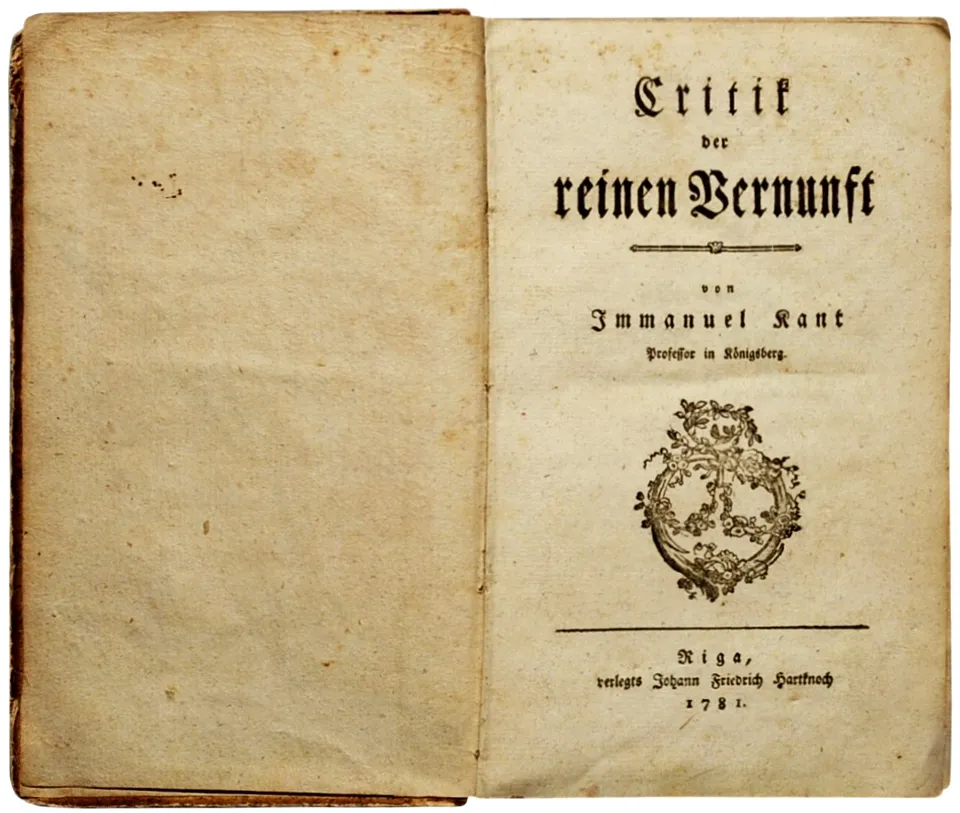
Published in 1781 by Johann Friedrich Hartknoch in Riga, the Critique of Pure Reason is Kant's masterwork: a culmination of several centuries of early modern philosophy and, at the same time, the inauguration of late modern philosophy. Its guiding question sounds technical but changed everything: how are synthetic a priori judgments possible?
Genesis & context
Over a decade of preparation, a manuscript written in months — and a wake-up call from Scotland.
By his own account, Kant spent at least twelve years thinking through the framework of the Critique before writing the actual manuscript in only four to five months — while carrying a full teaching load. He himself credited David Hume with the decisive push: it was the remembrance of Hume, he admitted, that first interrupted his “dogmatic slumber” and turned his investigations in a completely different direction.
The first edition of 1781 — 856 pages in the original German — initially received little attention, and soon drew fire from empiricist and rationalist critics alike, becoming a source of lasting controversy. Kant followed up with the much shorter Prolegomena to Any Future Metaphysics, and in 1787 he published a substantially revised second edition. Scholars have cited the work by its two versions ever since: “A” for 1781, “B” for 1787.
Source: Wikipedia: Critique of Pure Reason (publication and reception)
Structure & core ideas
The question driving the whole book: how are synthetic a priori judgments possible?
Before Kant, philosophers assumed that all a priori knowledge must be analytic — true by definition, adding nothing new. Kant argues that mathematics, the first principles of natural science and metaphysics make claims that are both a priori and genuinely informative. Explaining how that is possible sets the plan of the book.
- 1Transcendental Aesthetic
Space and time are not features of reality out there but pure forms of intuition — the mind's own way of receiving appearances. That is why mathematics can be certain and a priori.
- 2Transcendental Analytic
The “logic of truth”: twelve categories of the understanding — including substance and causality — structure everything we can think and experience. They are not read off the senses; they are a priori conditions of experience itself.
- 3Transcendental Dialectic
The “logic of illusion”: reason overreaches when it speculates about the soul, the world as a whole and God. Kant dismantles the paralogisms, the four antinomies and the classical proofs of God's existence — famously arguing that existence is not a real predicate.
- 4Transcendental Doctrine of Method
The closing part draws the consequences: the discipline, canon, architectonic and history of pure reason — a building code for any future philosophy.
Source: Wikipedia: Critique of Pure Reason (structure)
At the centre stands Kant's Copernican revolution. Instead of assuming that our knowledge must conform to objects — an assumption that had led metaphysics into failure — Kant proposes the reverse experiment: suppose that objects must conform to our knowledge. The price of this turn is a limit: we know things only as appearances, structured by space, time and the categories, never as they are in themselves. This transcendental idealism, Kant insists, is not Berkeley's subjective idealism — it is precisely what makes objective science of the world of experience possible.
Source: Wikipedia: Critique of Pure Reason (Copernican revolution, transcendental idealism)
Hitherto it has been assumed that all our knowledge must conform to objects. But all attempts to extend our knowledge of objects by establishing something in regard to them a priori, by means of concepts, have, on this assumption, ended in failure. We must therefore make trial whether we may not have more success in the tasks of metaphysics, if we suppose that objects must conform to our knowledge.
Kant, Critique of Pure Reason, B XVI (1787), transl. N. Kemp Smith
The first sentence of the preface
Critique of Pure Reason, A VII · Ak. 4:7
Kant's German original
Die menschliche Vernunft hat das besondere Schicksal in einer Gattung ihrer Erkenntnisse: dass sie durch Fragen belästigt wird, die sie nicht abweisen kann, denn sie sind ihr durch die Natur der Vernunft selbst aufgegeben, die sie aber auch nicht beantworten kann, denn sie übersteigen alles Vermögen der menschlichen Vernunft.
The exercise uses our own close translation, which keeps Kant's sentence structure.
Which parts can you leave out without the sentence falling apart? Tap them and they step back. Then check your choice.
Human reason has the peculiar fate in one kind of its cognitions: that it is burdened with questions which it cannot dismiss, for they are set before it as tasks by the nature of reason itself, but which it also cannot answer, for they surpass every capacity of human reason.
Plain words: our paraphrase, not a Kant quotation
With certain questions our reason is stuck. It cannot stop asking them, because they come from reason itself. But it cannot answer them either, because the answer would lie beyond everything we are able to know. A few lines later Kant names the battlefield of these questions: metaphysics.
The slider unlocks once you have checked your choice.
The frame: Human reason has the peculiar fate that it is burdened with questions which it cannot dismiss, but which it also cannot answer.
Stepping back does not mean unimportant. The two “for” clauses give the reasons: the questions come from reason itself, and they reach beyond everything it can do. The whole book examines exactly this rift. “In one kind of its cognitions” also narrows it down: not all of reason's questioning ends like this, only the metaphysical kind.
Key words
Once you have checked your choice, the underlined words can be opened.
Tap an underlined word in the sentence.
reason (Vernunft)
- In Kant
- The faculty that keeps asking from one condition to the next. On the same page Kant says it climbs “ever higher, to more remote conditions” (Ak. 4:7, our translation).
- In everyday speech
- “Be reasonable!” means: be sensible, don't do anything silly.
- Easy to confuse
- Not good sense is meant here, but a power of thought that cannot stop asking, even where no experience gives an answer any more.
set as tasks (aufgegeben)
- In Kant
- Set as a task: the nature of reason puts these questions to it, and it cannot get rid of them.
- In everyday speech
- In today's German “aufgeben” mostly means to give up, or to post a parcel.
- Easy to confuse
- The very opposite of giving up is meant: reason does not abandon the questions; they are set for it, like homework.
capacity (Vermögen)
- In Kant
- An ability of the mind to accomplish something. Kant speaks, for example, of the faculty of cognition and the faculty of desire.
- In everyday speech
- In everyday German, “Vermögen” is money and property: a fortune.
- Easy to confuse
- It has nothing to do with money. “Surpassing every capacity” means: none of our abilities is enough for it.
Impact & relevance today
From a controversial doorstopper to the founding document of modern philosophy.
The Critique has exerted an enduring influence on Western philosophy and helped bring about German idealism — the movement of Fichte, Schelling and Hegel that dominated the decades after Kant. Its four antinomies, its critique of the ontological, cosmological and design arguments for God, and its distinction between appearances and things in themselves have remained reference points of philosophical debate ever since.
Its deepest legacy, though, is a change of perspective: after the Critique, the first question of philosophy is no longer what the world is like, but what our minds contribute to any world we can know. Every later theory of knowledge and science has had to position itself with or against Kant.
NoteA court for reason
… to set up a court of justice that would secure it in its rightful claims …
Reference: Critique of Pure Reason, preface to the 1st edition (A xi f.), Ak. 4:9 · Read the original
By “it” Kant means reason itself. His critique is meant to test what reason may rightfully claim and what not. That is where the image of a workshop full of testing instruments comes from.
Translation: Our own translation of the German original.
New in your logbook · See the collection