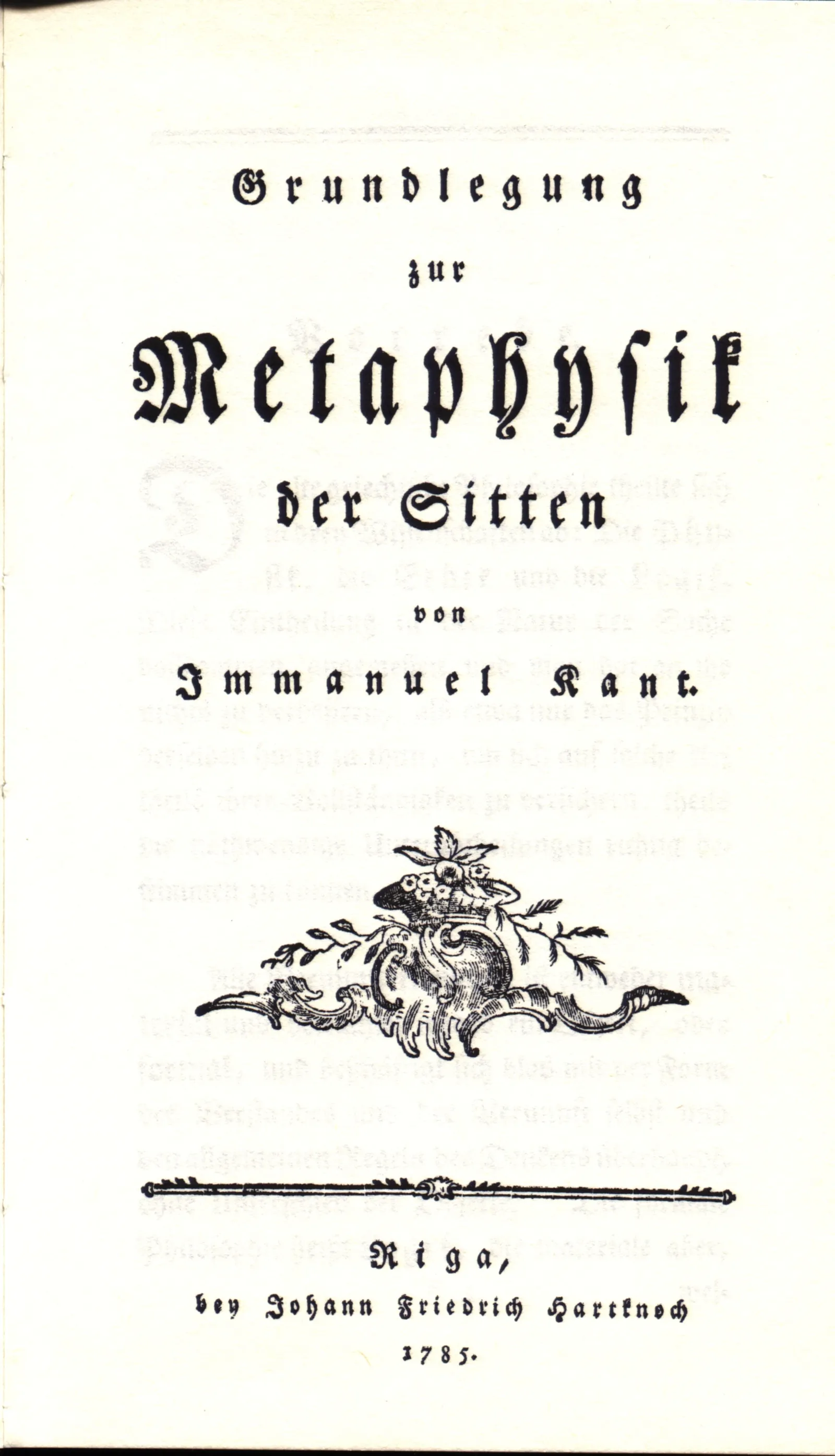
Groundwork of the Metaphysics of Morals
In roughly a hundred pages Kant searches for the supreme principle of morality — and finds it in the categorical imperative. This slim book of 1785 is his first mature work on ethics and remains one of the most influential moral treatises ever written.
The Groundwork does not yet offer a full system of duties. Its task is foundational: what makes an action morally good at all? Kant's answer breaks with traditions that built morality on happiness or human nature — moral philosophy, he argues, must rest on pure reason alone.
Origins & context
After the Critique of Pure Reason, Kant turns to morality.
Published in 1785, the Groundwork is the opening act of Kant's practical philosophy. In the preface he separates two kinds of inquiry: empirical study of how people actually behave, and pure moral philosophy, which asks a priori what ought to bind every rational being. Only the second, Kant insists, can identify and establish the supreme principle of morality — and precisely that is the book's declared purpose.
The Groundwork stands first in a trilogy. The Critique of Practical Reason (1788) deepens the justification of the moral law; The Metaphysics of Morals (1797) finally works the foundation out into a system of concrete duties of right and of virtue. Read in sequence, the three books show Kant moving from the question of what morality is grounded in to the question of what, in detail, it demands.
Source: Wikipedia: Groundwork of the Metaphysics of Morals (preface, context)
Structure & key ideas
Three sections lead from everyday moral common sense to the question of why the moral law binds us.
- 1From common-sense morality to the supreme principle
Kant starts from ordinary moral knowledge — and from his most famous claim: a good will is not good because of what it accomplishes, but good in itself, through its willing alone. His shopkeeper example sharpens the point: a merchant who treats even inexperienced customers fairly only because it pays — his advantage requires it — acts in accordance with duty, but not from duty — and only acting from duty has genuine moral worth.
- 2From popular moral philosophy to a metaphysics of morals
The second section develops the theory of imperatives. Hypothetical imperatives bind only on condition of an end you happen to have; the categorical imperative binds every rational agent unconditionally. Kant unfolds it in several formulations — universal law, humanity as an end in itself, autonomy, the kingdom of ends — and tests maxims against it, most famously the false promise: universalised, it would destroy the very institution of promising, a contradiction in conception.
- 3Establishing freedom and self-legislation
The final section asks why the categorical imperative holds. Kant's answer works through freedom: we can view ourselves from two standpoints — as part of the phenomenal world of natural causes, and as members of an intelligible world of freedom. For Kant, “a free will and a will under moral laws are one and the same”: to act freely just is to act under self-given moral law.
Sources: Wikipedia: Groundwork of the Metaphysics of Morals (summary of the three sections) · Kant, Groundwork, Ak. 4:397 (shopkeeper example)
Act only in accordance with that maxim through which you can at the same time will that it become a universal law.
Kant, Groundwork of the Metaphysics of Morals (1785), Ak. 4:421, translated
- Maxim
- The principle of volition on which a person actually acts — the raw material that the categorical imperative puts to the test.
- Formula of Universal Law
- Act only on a maxim you could at the same time will as a universal law (quoted above) — the core universalisability test.
- Formula of Humanity
- Use humanity, in your own person and in every other, always at the same time as an end and never merely as a means — the seed of the modern idea of human dignity.
- Autonomy & the kingdom of ends
- Every rational will legislates universally through its maxims; together such agents form a kingdom of ends, in which persons have dignity rather than a price that could be exchanged.
Kant does not leave the test abstract. Alongside the false promise he examines maxims of suicide, of letting one's talents rust and of refusing help to others in need. Some maxims fail because they cannot even be conceived as universal law; others can be conceived, but no rational agent could consistently will them — after all, everyone at some point depends on the help of others. Duties to oneself and duties to others, strict and wide, thus flow from a single principle.
Source: Wikipedia: Groundwork of the Metaphysics of Morals (formulations of the categorical imperative)
The first sentence of the first section
Groundwork of the Metaphysics of Morals · Ak. 4:393
Kant's German original
Es ist überall nichts in der Welt, ja überhaupt auch außer derselben zu denken möglich, was ohne Einschränkung für gut könnte gehalten werden, als allein ein guter Wille.
The exercise uses our own close translation, which keeps Kant's sentence structure.
Which parts can you leave out without the sentence falling apart? Tap them and they step back. Then check your choice.
There is nothing anywhere in the world, indeed nothing even beyond it that can be conceived, which could be held to be good without limitation, except a good will alone.
Plain words: our paraphrase, not a Kant quotation
Take everything that can be called good: intelligence, courage, power, health. Each of them can also do harm, depending on who uses it and for what. Only one thing is good in every case: a good will.
The slider unlocks once you have checked your choice.
The frame: There is nothing anywhere in the world which could be held to be good without limitation, except a good will alone.
Stepping back does not mean unimportant. The insertion intensifies the claim: even beyond the world, nothing else can be conceived that would be good without limitation.
Key words
Once you have checked your choice, the underlined words can be opened.
Tap an underlined word in the sentence.
without limitation (ohne Einschränkung)
- In Kant
- Good in every situation, whatever it is used for. Understanding, courage or resolve are good only with conditions: they can become “extremely evil and harmful” if the will is not good (Ak. 4:393, our translation).
- In everyday speech
- “Without limitation” sounds like agreeing wholeheartedly, no ifs and buts.
- Easy to confuse
- It is not about how strongly you approve of something, but whether it stays good under all circumstances. According to Kant, only a good will manages that.
good will (guter Wille)
- In Kant
- A will that is good “through its willing alone”, not through what it brings about. Even if it achieved nothing, it would still “shine like a jewel for itself” (Ak. 4:394, our translation).
- In everyday speech
- “He showed goodwill” means: at least he tried.
- Easy to confuse
- Not a mere wish or a nice intention: Kant explicitly means “the summoning of all means, as far as they are in our power” (Ak. 4:394, our translation).
Sources: German original (korpora.org): Ak. 4:393 · German original (korpora.org): Ak. 4:394
Reception & why it matters today
Fiercely attacked, endlessly discussed — and still the founding text of deontological ethics.
The Groundwork has never lacked critics. Schopenhauer, in 1840, attacked its foundation head-on and found the categorical imperative cold and egoistic; Nietzsche went further and called the categorical imperative “dangerous to life”, accusing impersonal duty of ruining the individual. Twentieth-century scholars such as Lewis White Beck added a different caution: readers who stop at the Groundwork miss the fuller statement of Kant's moral theory in the Critique of Practical Reason.
And yet the book remains one of the most influential works in the history of ethics. Its central ideas — rational autonomy, principles that must hold for everyone, the human being as an end in itself — continue to shape deontological ethics and rights-based moral and political philosophy. Wherever human dignity is treated as something that may never be traded off against convenience, the Groundwork's Formula of Humanity is still doing its work.
Source: Wikipedia: Groundwork of the Metaphysics of Morals (reception, influence)