The Metaphysics of Morals
Kant's final major work in moral philosophy: what the Groundwork and the Critique of Practical Reason had established as a principle is here applied to real life — to right, the state and virtue.
The work appeared in 1797 in two parts: the Doctrine of Right (Rechtslehre) was published separately around January, the Doctrine of Virtue (Tugendlehre) followed in August. Together they form Kant's system of duties: the Doctrine of Right asks which external order secures everyone's freedom; the Doctrine of Virtue asks which ends a person ought to make their own inner duty.
Origins & context
A late work that completes a long-announced programme.
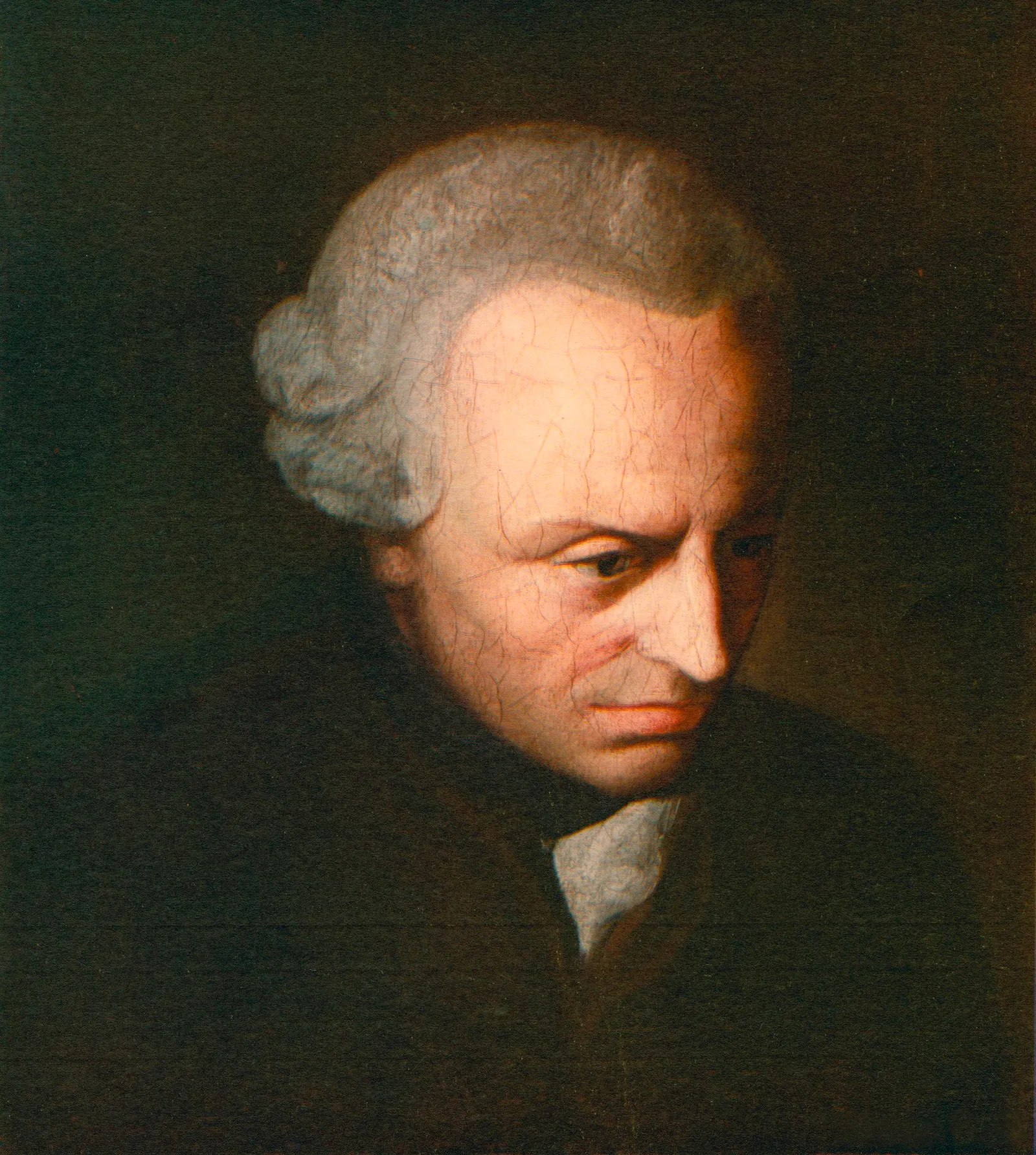
When the Metaphysics of Morals appeared in 1797, Kant was 72 years old. The book develops the political and ethical philosophy he had grounded in the Groundwork of the Metaphysics of Morals (1785) and the Critique of Practical Reason (1788) — the very title of the Groundwork had pointed towards this larger work. The earlier writings had sought and justified the supreme principle of morality, the categorical imperative; the late work builds the system of duties that follows from it.
The two parts address two sides of morality: the Doctrine of Right deals with the rights people possess and the external relationships between persons; the Doctrine of Virtue examines the virtues individuals ought to acquire and the inner requirements of morality. In 1798 Kant issued a revised second edition of the Doctrine of Right, adding an appendix in which he responded to a review by Friedrich Bouterwek.
Source: Wikipedia: The Metaphysics of Morals (publication and structure)
Structure & core theses
Two doctrines, one principle: freedom under universal law.
Any action is right if it can coexist with everyone's freedom in accordance with a universal law, or if on its maxim the freedom of choice of each can coexist with everyone's freedom in accordance with a universal law.
Kant, The Metaphysics of Morals (1797), Doctrine of Right § C, Ak. 6:230
This universal principle of right anchors the Doctrine of Right, which works out property rights, punitive justice, the right of the state, the right of nations and cosmopolitan right within a republican framework — the philosophical foundation of political community and positive law. Kant allows no right of resistance or rebellion against the supreme legislative power — even where it abuses its power; only public complaints and criticism are permitted (Ak. 6:319 f.).
Source: Wikipedia: The Metaphysics of Morals (Doctrine of Right)
- Doctrine of Right
- Concerns external relationships between persons: which actions are compatible with everyone's freedom under a universal law. It covers property, punishment, the state, the right of nations and cosmopolitan right.
- Doctrine of Virtue
- Concerns the inner side of morality: the duties of virtue we owe to ourselves and to others, and the ends that are at the same time duties.
- Perfect duties
- Duties that allow no discretion — such as the prohibitions on lying and on suicide.
- Imperfect duties
- Duties that permit latitude in how we fulfil them — such as cultivating one's talents and practising beneficence.
- Duties to others
- Duties of love (beneficence, gratitude, sympathy) and of respect belong here: every human being has a rightful claim to respect from others and owes it to everyone in turn; throughout, humanity must be treated as an end in itself, never merely as a means.
- Duties to oneself
- Alongside the ban on suicide, Kant demands self-respect: servility — throwing away one's own dignity — is to be avoided.
Source: Wikipedia: The Metaphysics of Morals (Doctrine of Virtue)
The universal principle of right
Metaphysics of Morals, Doctrine of Right, § C · Ak. 6:230
Kant's German original
Eine jede Handlung ist recht, die oder nach deren Maxime die Freiheit der Willkür eines jeden mit jedermanns Freiheit nach einem allgemeinen Gesetze zusammen bestehen kann.
The exercise uses our own close translation, which keeps Kant's sentence structure.
Which parts can you leave out without the sentence falling apart? Tap them and they step back. Then check your choice.
Every action is right which, or according to whose maxim the freedom of choice of each, can coexist with everyone's freedom in accordance with a universal law.
Plain words: our paraphrase, not a Kant quotation
An action is rightful if it fits together with everyone else's freedom, according to a rule that applies equally to all. My freedom reaches as far as it leaves the same freedom of others intact.
The slider unlocks once you have checked your choice.
The frame: Every action is right which can coexist with everyone's freedom in accordance with a universal law.
Stepping back does not mean unimportant. The little word “which” is load-bearing: what is right is first of all the action itself that can coexist with everyone's freedom. The addition only opens a second route, through the maxim. Right does not demand the right disposition (Ak. 6:231); only the “external” relation between people counts (Ak. 6:230).
Key words
Once you have checked your choice, the underlined words can be opened.
Tap an underlined word in the sentence.
right (recht)
- In Kant
- Rightful. According to Kant, right concerns only “the external and indeed practical relation of one person to another” (Ak. 6:230, our translation).
- In everyday speech
- In German, “das ist mir recht” means “fine by me”; “Recht haben” means being correct.
- Easy to confuse
- Neither agreement nor being correct. What is meant is what is compatible with right, even if in my heart I “would gladly infringe” the other's freedom (Ak. 6:231, our translation).
maxim (Maxime)
- In Kant
- The rule by which a person actually acts. “A maxim is the subjective principle of volition” (Ak. 4:400 note, our translation).
- In everyday speech
- A maxim sounds like a personal motto: “My maxim: always be on time.”
- Easy to confuse
- The personal motto is actually not far off. What matters is: a maxim is my own rule, not a law imposed from outside.
choice (Willkür)
- In Kant
- The capacity “to do or to refrain as one pleases”, combined with the awareness of being able to bring something about (Ak. 6:213, our translation).
- In everyday speech
- In today's German “Willkür” is an accusation: arbitrariness, as in an arbitrary verdict.
- Easy to confuse
- No accusation: for Kant, “Willkür” is the capacity to choose; it is free insofar as sensuous impulses do not determine it (Ak. 6:213). Right makes sure that one person's free use of choice has room next to another's.
Sources: German original (korpora.org): Ak. 6:230 · German original (korpora.org): Ak. 6:231 · German original (korpora.org): Ak. 6:213 · German original (korpora.org): Ak. 4:400
Legacy & relevance today
From neglected late work to a key text of legal and moral philosophy.
For a long time the Metaphysics of Morals stood in the shadow of Kant's earlier moral writings: in English-speaking academia it initially received far less attention than the Groundwork or the second Critique. That changed with the scholarship and groundbreaking translation of Mary J. Gregor, beginning with her 1963 book Laws of Freedom, which helped restore the work to its place in Kant's practical philosophy.
Today the book is read as the completion of Kant's ethics and as his political philosophy in its mature form: the universal principle of right, the republican grounding of the state and positive law, and the systematic account of duties to oneself and to others show how the categorical imperative becomes concrete. Whoever knows only the Groundwork knows the principle — the Metaphysics of Morals shows the system.