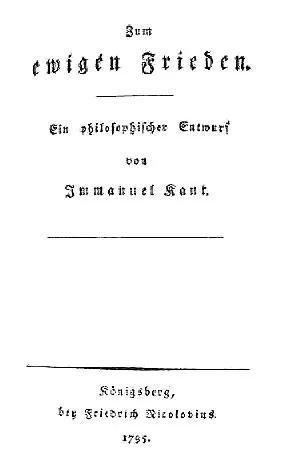
Perpetual Peace
A philosopher drafts a peace treaty: in this late work Kant sets out the legal conditions under which wars would not merely pause but become impossible in principle — an idea that echoes all the way into the Charter of the United Nations.
Genesis & form
A treaty written by a philosopher — with articles, supplements and appendices.
The essay appeared in 1795, published by Nicolovius in Königsberg, under the German title Zum ewigen Frieden. Ein philosophischer Entwurf — a “philosophical sketch” of perpetual peace. It belongs to the great final phase of Kant's writing: it follows his 1793 essay on theory and practice and precedes the Metaphysics of Morals of 1797, in which he worked his doctrine of right out in full.
What makes the text unique is its form. Kant does not write a treatise about peace; he drafts the peace itself, structured like a real treaty between states: six preliminary articles, three definitive articles, two supplements — including a secret article — and two appendices on the tense relationship between morals and politics. The philosopher, in other words, hands the politicians a document they could in principle sign.
The argument: prohibitions and conditions
First remove what breeds war — then build peace on three levels of law.
The six preliminary articles are prohibitions, meant to clear away the standing causes of war:
- 1. Honest peace
- No peace treaty is valid if it secretly reserves material for a future war — that would be a mere truce.
- 2. No trading states
- No independent state may be acquired by another through inheritance, exchange, purchase or donation.
- 3. Disarmament
- Standing armies shall in time be totally abolished — their mere existence threatens other states even in peacetime.
- 4. No war credit
- No national debts shall be contracted for the external conflicts of the state.
- 5. Non-interference
- No state shall forcibly interfere with the constitution or government of another.
- 6. No dirty war
- In war, no acts that would make future mutual trust impossible: assassins, poisoners, breach of capitulation, incitement to treason.
Source: Wikipedia: Perpetual Peace (preliminary articles)
The heart of the essay lies in the three definitive articles, which construct peace positively:
- 1A republican constitution
The civil constitution of every state shall be republican: for Kant that means a representative system in which the legislature is separated from the executive — emphatically not direct democracy. Republics, he argues, incline toward peace, because those who must bear the costs of war have a say in declaring it.
- 2A federation of free states
The law of nations shall be founded on a federation of free states. A world republic (a state of nations) would be, for Kant, the rational solution “in thesi”; because states will not accept it, a league of independent republics stands in as its “negative surrogate” — a federation for peace. A universal monarchy he rejects as a “soulless despotism”.
- 3Cosmopolitan hospitality
Cosmopolitan right shall be limited to conditions of universal hospitality: a stranger arriving peacefully may not be treated as an enemy, though he has a right to visit, not a right to be treated as a guest — and may be turned away only if this does not cause his death.
Sources: Wikipedia: Perpetual Peace (definitive articles) · Kant, Perpetual Peace, Ak. 8:357 and 367 (Academy edition, korpora.org)
Standing armies shall in time be totally abolished.
Kant, Perpetual Peace (1795), Third Preliminary Article (Ak. 8:345)
Source: Wikipedia: Perpetual Peace (quotations)
The first preliminary article
Perpetual Peace, first preliminary article · Ak. 8:343
Kant's German original
Es soll kein Friedensschluss für einen solchen gelten, der mit dem geheimen Vorbehalt des Stoffs zu einem künftigen Kriege gemacht worden. Denn alsdann wäre er ja ein bloßer Waffenstillstand, Aufschub der Feindseligkeiten, nicht Friede, der das Ende aller Hostilitäten bedeutet, und dem das Beiwort ewig anzuhängen ein schon verdächtiger Pleonasm ist.
The exercise uses our own close translation, which keeps Kant's sentence structure.
Which parts can you leave out without the sentence falling apart? Tap them and they step back. Then check your choice.
No treaty of peace shall count as one if it was made with a secret reservation of material for a future war. For then it would be a mere armistice, a postponement of hostilities, not peace, which means the end of all hostilities, and to which to attach the epithet “perpetual” is already a suspicious pleonasm.
Plain words: our paraphrase, not a Kant quotation
A peace treaty does not count if one side is secretly keeping back the reason for the next war. That would only be a pause between two wars. Genuine peace ends all hostilities; that is why “perpetual peace” really says the same thing twice.
The slider unlocks once you have checked your choice.
The frame: No treaty of peace shall count as one if it was made with a secret reservation of material for a future war. For then it would be a mere armistice, not peace, which means the end of all hostilities.
Stepping back does not mean unimportant. Kant's point is hidden in the last addition: if peace already means the end of all hostilities, “perpetual peace” says the same thing twice.
Key words
Once you have checked your choice, the underlined words can be opened.
Tap an underlined word in the sentence.
reservation (Vorbehalt)
- In Kant
- Something you secretly hold back when concluding a treaty: here, the intention of going to war again later.
- In everyday speech
- You have reservations when you are sceptical: “I have my reservations.”
- Easy to confuse
- Not scepticism is meant, but a hidden back door in the treaty.
material (Stoff)
- In Kant
- Occasion and material for a future quarrel. A genuine peace treaty is meant to have “altogether annihilated” all causes of future wars (Ak. 8:343, our translation).
- In everyday speech
- In German “Stoff” is fabric for clothes, or the material you learn for an exam.
- Easy to confuse
- Neither textile nor syllabus: more like the fuel you store up for the next war.
pleonasm (Pleonasm)
- In Kant
- A doubled statement that adds nothing, like “free gift”. If peace already is the end of all hostilities, every genuine peace is perpetual.
- In everyday speech
- Familiar from school: a stylistic slip, saying the same thing twice.
- Easy to confuse
- Kant is not criticising style here; he is making a point: genuine peace does not need the epithet “perpetual” at all, it already is.
Impact & relevance today
From Wilson's Fourteen Points to the League of Nations and the United Nations.
Few philosophical essays have shaped world politics so directly. Ideas of the kind Kant defended — that responsible governments favour peace and commerce — resurfaced in Woodrow Wilson's liberal internationalism and his Fourteen Points, the last of which called for the association of nations that became the League of Nations. In 1914 H. G. Wells, in “The War That Will End War”, hoped that crushing Prussian imperialism and rebuilding Europe as a largely disarmed association of states would end war for good — he does not cite Kant, but the hope is of a kindred spirit. Scholars have long noted that the ideology of the United Nations Charter reflects Kant's vision of a lawful peace among states.
The essay also founded whole research programmes. Democratic peace theory — the finding that democracies rarely fight one another — traces straight back to the first definitive article. Norman Angell's The Great Illusion (1910) argued, in a line of thought parallel to Kant's commercial peace, that modern trade makes war unprofitable even for the victor; proposals for peace through international institutions likewise echo Kant's federation of free states. Republic, federation, hospitality: two centuries on, the three definitive articles still read like a checklist for the international order we are trying to build.
Sources: Wikipedia: Perpetual Peace (influence, democratic peace) · Wilson, Fourteen Points (1918), point XIV (Yale Avalon Project) · H. G. Wells, The War That Will End War (1914), Project Gutenberg
Continue in the Peace & politics chapter — from Kant's federation to the League of Nations and the UN.